an office & a schedule
With the house now liveable, and basic items finding their way to appropriate new locations, I've begun to put my office together, unpacking reference books and office supplies and a few books to research and hopefully sell. Some months back, I had written in these pages about the fear of packing my library; the idea that I might never again see some of these old friends. The fear was, of course, unfounded, and here these friends are once again (at least some of them for the time being).
The biggest task at hand is returning to some type of routine in the office. I have more than lots to do, as my archiving work has left me with numerous archives catalogued but not yet compiled. Lots of recent travel has created a topsy turvy schedule, but things begin to fall into place. Sam and I have coffee together before she heads off to the bakery in the morning, and after she leaves I head outside for a half-hour to hour of minor field work or wood splitting. Fixing fence wire, pruning apple trees or cutting back dead brush is as good as the coffee for a brace in the morning, and after that I can have a bite to eat and sit down to work. More time can be spent outdoors at the height of the day, when it's warmer, and then back to the computer again. Around five, a final hour or so outdoors is a good way to wind down the day before dinner preparations begin.
With this new schedule, I can hope to accomplish my office work and my many outdoor projects.
Thursday, March 09, 2006


the sap buckets are up
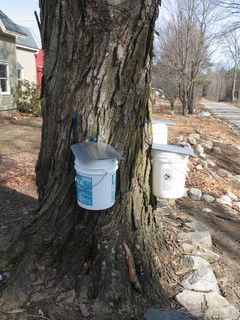
Just a week or two ago, the folks from Giles Family Farm came by to hang sap buckets on our sugar maples. We had heard that local homeowners let them tap their trees in exchange for a bit of the final product and some communal sharing. For days now the buckets have been empty save for a few drops of what I assumed were rain water. But yesterday a multi-generational crew from the Giles family were out front with a pickup-mounted collecting tank, gathering sap from buckets along both sides of the road. Surprisingly, the buckets were now more than half full, and one of the collectors (my guess is Mr. Giles) told me that by this Saturday, the warm weather would have them running at full speed - three or more drops per second.
The Giles family sugar shack is about two miles from here, and a drive to the location requires passing hundreds of the metal or plastic buckets, some with the traditional metal spigot, others with a plastic spigot and short hose. Where the trees extend up the slopes of hills, the hoses are joined into a winding circuit of gravity driven delivery, with larger collecting tanks at the bottom.
I hope to visit the sugar shack soon (they said to come after two pm most days, as it takes that long to get the boil going). And I hear there is a Maple Sugar Day in the next month or so, when the sugar makers hold open houses.
I realised later that the Giles family operates a large orchard nearby as well, and that when they came by to collect, I was in the middle of a severe pruning of our two overgrown apple trees. Two minutes of conversation with them could probably have saved me the hours of reading about pruning, and resulted in a much less scalped looking tree. I'm sure they gaot a good chuckle out of the city boys orchard skills.
Just a week or two ago, the folks from Giles Family Farm came by to hang sap buckets on our sugar maples. We had heard that local homeowners let them tap their trees in exchange for a bit of the final product and some communal sharing. For days now the buckets have been empty save for a few drops of what I assumed were rain water. But yesterday a multi-generational crew from the Giles family were out front with a pickup-mounted collecting tank, gathering sap from buckets along both sides of the road. Surprisingly, the buckets were now more than half full, and one of the collectors (my guess is Mr. Giles) told me that by this Saturday, the warm weather would have them running at full speed - three or more drops per second.
The Giles family sugar shack is about two miles from here, and a drive to the location requires passing hundreds of the metal or plastic buckets, some with the traditional metal spigot, others with a plastic spigot and short hose. Where the trees extend up the slopes of hills, the hoses are joined into a winding circuit of gravity driven delivery, with larger collecting tanks at the bottom.
I hope to visit the sugar shack soon (they said to come after two pm most days, as it takes that long to get the boil going). And I hear there is a Maple Sugar Day in the next month or so, when the sugar makers hold open houses.
I realised later that the Giles family operates a large orchard nearby as well, and that when they came by to collect, I was in the middle of a severe pruning of our two overgrown apple trees. Two minutes of conversation with them could probably have saved me the hours of reading about pruning, and resulted in a much less scalped looking tree. I'm sure they gaot a good chuckle out of the city boys orchard skills.
Tuesday, February 28, 2006

first book fair in a while
I exhibited again this year at the Greenwich Village Antiquarian Book Fair and had a great time and a very good fair sales wise. This small, collegial, neighborhood fair has become one of the better fairs of the year for me. Sales were strong on Friday night and Sunday, and I met a few interesting people on Saturday. Most of sales were squarely in the avant-gardes, with books and ephemera by Andy Warhol, Alan Kaprow, Ed Ruscha and John Cage. A few pieces of modern lit. went to dealer friends of mine, including books by Kerouac, Ray Bradbury and Tennesee Williams.
I bought well, returning with two bags of books which included a nearly unique book sculpture from 1969, the rare catalogue/box for Paolo Soleri's exhibition at the Corocaran Gallery in 1970, an additional copy of the Schwarz/Duchamp Readymades catalogue (I was protecting my price), Waverly Root's Food of Italy, inscribed by the designer Warren Chappel, and a nice clean copy of Joseph Mitchell's 'The Bottom of the Harbor'. In short, something in every category in which I buy.
Other dealers had various reactions - which in my experience is the way this works. It can never be predicatable, and efforts to "understand" sales from fair to fair are pretty futile efforts. Books I brought specially for a particular customer sat in the case, while other things I may have easily left at home sold. There were several new dealers (or first time exhibitors) this year, and they seemed happy enough. I didn't hear anyone say they were not returning except Bill Boyer, who has done this fair longer than anyone else, and says, as we all do, that it's harder to find good books these days.
I will try the April NYC satellite fair this year (called the Carriage House Fair), and cross my fingers for entry into the ABAA next year. Then I'll hop on the waiting list for the New York ABAA fair, which is certainly the fair most worth doing in the states. The fall Armory fair remains useful for me, although there is a lot of complaining about the rising prices and falling crowds. In my opinion the falling crowds are the bigger problem, partially due to the boring neighborhood where the downtown armory is located. The Greenwich Village fair benefits greatly from being in a neighborhood traditionally interested in literature and the arts, and one which now has lots of well-heeled folks willing to drop in to browse, whereas no one goes to the Lexington Avenue Armory who is not already highly motivated.
I did not attend LA this year, but many dealer friends of mine did. The word I heard was that it was OK to good, although the art related dealers didn't do well. The LA fair remains fairly narrow and unsophisticated to my taste: modern lit., film related books, Americana, etc. (not that these fields are unsophisticated, just that there are not so many other diverse fields
well-represented).
Contrary to some of the words on book blogs these days, book fairs are not dead, they've just changed, like the rest of bookselling.
I exhibited again this year at the Greenwich Village Antiquarian Book Fair and had a great time and a very good fair sales wise. This small, collegial, neighborhood fair has become one of the better fairs of the year for me. Sales were strong on Friday night and Sunday, and I met a few interesting people on Saturday. Most of sales were squarely in the avant-gardes, with books and ephemera by Andy Warhol, Alan Kaprow, Ed Ruscha and John Cage. A few pieces of modern lit. went to dealer friends of mine, including books by Kerouac, Ray Bradbury and Tennesee Williams.
I bought well, returning with two bags of books which included a nearly unique book sculpture from 1969, the rare catalogue/box for Paolo Soleri's exhibition at the Corocaran Gallery in 1970, an additional copy of the Schwarz/Duchamp Readymades catalogue (I was protecting my price), Waverly Root's Food of Italy, inscribed by the designer Warren Chappel, and a nice clean copy of Joseph Mitchell's 'The Bottom of the Harbor'. In short, something in every category in which I buy.
Other dealers had various reactions - which in my experience is the way this works. It can never be predicatable, and efforts to "understand" sales from fair to fair are pretty futile efforts. Books I brought specially for a particular customer sat in the case, while other things I may have easily left at home sold. There were several new dealers (or first time exhibitors) this year, and they seemed happy enough. I didn't hear anyone say they were not returning except Bill Boyer, who has done this fair longer than anyone else, and says, as we all do, that it's harder to find good books these days.
I will try the April NYC satellite fair this year (called the Carriage House Fair), and cross my fingers for entry into the ABAA next year. Then I'll hop on the waiting list for the New York ABAA fair, which is certainly the fair most worth doing in the states. The fall Armory fair remains useful for me, although there is a lot of complaining about the rising prices and falling crowds. In my opinion the falling crowds are the bigger problem, partially due to the boring neighborhood where the downtown armory is located. The Greenwich Village fair benefits greatly from being in a neighborhood traditionally interested in literature and the arts, and one which now has lots of well-heeled folks willing to drop in to browse, whereas no one goes to the Lexington Avenue Armory who is not already highly motivated.
I did not attend LA this year, but many dealer friends of mine did. The word I heard was that it was OK to good, although the art related dealers didn't do well. The LA fair remains fairly narrow and unsophisticated to my taste: modern lit., film related books, Americana, etc. (not that these fields are unsophisticated, just that there are not so many other diverse fields
well-represented).
Contrary to some of the words on book blogs these days, book fairs are not dead, they've just changed, like the rest of bookselling.
Sunday, February 12, 2006
some recent reading
The last 30 days have brought a final push on the renovation, the arrival of movers with the contents of our storage unit, and a bit of vacation travel. Despite all this, I've been reading a bit. Before our move into the farmhouse, we packed up the contents of the apartment in Kennebunk, a place I've enjoyed greatly for the last five years and filled with books. Reread Walter Benjamin's essay "On Unpacking My Library" again for the umpteenth time as I put the books into boxes. It's not the first time I've experienced a feeling of dreaded mortality while preparing my library for storage. The fear of not seeing these friends again. But I try to liken it to seeing loved ones off on a long sea voyage. The return of these books, when they are finally unpacked many months from now, will be so welcome.
The rest of my reading has been light, and the cold weather here in Maine has got me looking forward to spring and working outdoors in the garden and fields. William Echikson's Noble Rot was a great introduction to the current state of affairs in Bordeaux' wine industry, and paints a more nuanced picture of the influence of Robert Parker and Michel Rolland than did Jonathan Rossiter's Mondovino. While I'm sympathetic to Rossiter's anti-globalization point of view (when it comes to food culture at least), Parker and Rolland do seem to have spurred some of the more recalcitrant small farmers toward basic modern methods (and here I mean cleanliness and harvesting at the height of ripeness, not micro-oxygenation or GMA). For a look backwards at winemakers facing technology vs. natural methods issues, I recommend Christy Campbell's The Botanist and the Vintner, which describes the decades long struggle with the dreaded phyloxera. In the end, an understanding of the biology of the plant and the predator succeeded over what appear to have been fairly blind applications of pesticides (which were encouraged by the railroad companies, which profitted from shipping the chemicals in to the countryside). I read this last one during our recent trip to a wonderful little island in the Turks and Caicos, and the section which described French farmers moving their grape fields to essentially sand dunes on the Mediterranean shore and in Algeria got me wondering what might grow amidst the scrubby Carribean plants.
The last 30 days have brought a final push on the renovation, the arrival of movers with the contents of our storage unit, and a bit of vacation travel. Despite all this, I've been reading a bit. Before our move into the farmhouse, we packed up the contents of the apartment in Kennebunk, a place I've enjoyed greatly for the last five years and filled with books. Reread Walter Benjamin's essay "On Unpacking My Library" again for the umpteenth time as I put the books into boxes. It's not the first time I've experienced a feeling of dreaded mortality while preparing my library for storage. The fear of not seeing these friends again. But I try to liken it to seeing loved ones off on a long sea voyage. The return of these books, when they are finally unpacked many months from now, will be so welcome.
The rest of my reading has been light, and the cold weather here in Maine has got me looking forward to spring and working outdoors in the garden and fields. William Echikson's Noble Rot was a great introduction to the current state of affairs in Bordeaux' wine industry, and paints a more nuanced picture of the influence of Robert Parker and Michel Rolland than did Jonathan Rossiter's Mondovino. While I'm sympathetic to Rossiter's anti-globalization point of view (when it comes to food culture at least), Parker and Rolland do seem to have spurred some of the more recalcitrant small farmers toward basic modern methods (and here I mean cleanliness and harvesting at the height of ripeness, not micro-oxygenation or GMA). For a look backwards at winemakers facing technology vs. natural methods issues, I recommend Christy Campbell's The Botanist and the Vintner, which describes the decades long struggle with the dreaded phyloxera. In the end, an understanding of the biology of the plant and the predator succeeded over what appear to have been fairly blind applications of pesticides (which were encouraged by the railroad companies, which profitted from shipping the chemicals in to the countryside). I read this last one during our recent trip to a wonderful little island in the Turks and Caicos, and the section which described French farmers moving their grape fields to essentially sand dunes on the Mediterranean shore and in Algeria got me wondering what might grow amidst the scrubby Carribean plants.
Saturday, January 21, 2006
books?
I'm a little behind things these days, having been preoccupied with our ongoing renovation. But I've learned that Joyce Godsey has been busy creating a blog linked to the Bibliophile newsgroup, as well as one of her own. She was nice enough to link to Casa Malaprop, which will surely result in at leat one person clicking through, only to ask, "what the heck does this have to do with books?". To be honest, lately, not much. But until our recent complete emersion into the world of Home Depot and This Old House, Casa Malaprop was a place for my general thoughts on things mostly book related, with a occasional left turns to food and drink topics. Here's a promise to get back on track with more books news, reports on reading and the general fads and foibles of the books dealing world. Thanks for looking in the meantime.
I'm a little behind things these days, having been preoccupied with our ongoing renovation. But I've learned that Joyce Godsey has been busy creating a blog linked to the Bibliophile newsgroup, as well as one of her own. She was nice enough to link to Casa Malaprop, which will surely result in at leat one person clicking through, only to ask, "what the heck does this have to do with books?". To be honest, lately, not much. But until our recent complete emersion into the world of Home Depot and This Old House, Casa Malaprop was a place for my general thoughts on things mostly book related, with a occasional left turns to food and drink topics. Here's a promise to get back on track with more books news, reports on reading and the general fads and foibles of the books dealing world. Thanks for looking in the meantime.


Sunday, January 01, 2006


Subscribe to:
Posts (Atom)