Ehon: The Artist and the Book in Japan
The New York Public Library has a fantastic new exhibition up currently, titled Ehon: The Artist and the Book in Japan. Ehon surveys the development of the Japanese picture book, a 1350 year history which began in the eighth century. The survey extends through the Japanese Avant-Garde, including the MAVO movement, through to Anime and the contemporary photographic artist book. While I have not yet seen the exhibit, I did order the 380 page companion volume, published by the NYPL and the University of Washington Press. It a beautiful book, with enough illustration to truly draw you into these visual wonders. The show runs through February, 2007.
Friday, September 29, 2006

you can't play chess in flore...
Andrew Hussey's new book, Paris: the Secret History will be available this November, and it sounds like a good one. I might venture a bet that Paris has been the most profiled city in book lore (with new York and London as the other obvious contenders). The book claims to tell the history of the City of Light through its "whores and beggars... hustlers and vagabonds", and while Hussey recognizes the sad changes that the city's current touristic life requires (e.g. you can't play chess in Flore), he also reveals how Parisian life remains vital, and is perhaps experiencing a renaissance right now. Steven Poole has a lengthy review in the TLS.
Thursday, September 28, 2006

leonardo on paper
The Victoria & Albert Museum has a new exhibition, focussing on Leonardo Da Vinci's thought process as expressed on paper. The drawings include anatomical studies, mathematical expressions and designs for machinery.
Friday, September 22, 2006
 a new collected camus
 Gallimard has issued an expanded and corrected complete works of Camus in its venerable Bibliotheque de la Pleiade series. Robin Buss has a review in the TLS.
sweet pages
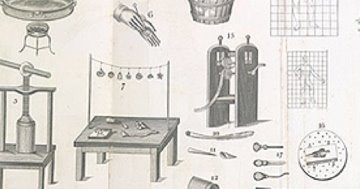
Tim Richardson is the author of a history of confectionery entitled Sweets: History of a Temptation,(in America the title has been appropriately dumbed down to Sweets: A History of Candy) The British Library has a short interview and an illustrated selection of his favorite books from the history of sweets.
Sunday, September 10, 2006
more about haying
We have about seven or eight acres of open pasture. It's been used for hay in the past, but was quickly headed toward becoming a field of weeds and, eventually, a woods again. Our neighbor Dave was kind enough to let me use his Farmall A with a sickle bar mower to cut the grass. Originally my plan was just to cut it before the weeds went to seed, and let it rot in the field as fertilizer for next year's hopefully healthier crop of hay. Hay mowing, it turns out, is nothing like mowing the lawn. It's hard work, especially on an older tractor (this one's from around 1943). At times one is practically wrestling with the machine to keep the sickle bar clear of clumps of hay, and the tractor in something of a straight line. I finished about half of the fields and had to stop mowing to replace the wooden pitman bar, a piece which is made of wood so that it might break if too much pressure is put on the blades, so as to not transmit the problem to the tractor's PTO (no need to explain this) or through to the engine.
 Fortunately, I was approached just then by a local farmer who asked if he could hay the field, and keep a percentage of the crop. I don't have access to the equipment to do a full haying myself, to say nothing of the required skill, so I jumped at the chance to watch someone who knows what they're doing cut the field. A few days later, some diesel pickups could be spotted idling at the edge of the field while the farmer, John T. and his crew made a plan. The cutting which remained was dispatched by John's son Jonathan, with a much more exact execution, making my half of the field look amateurish and uneven, with clumps of uncut grass and weeds still sticking up straight. Jonathan's rows were trimmed evenly, and they were straight.
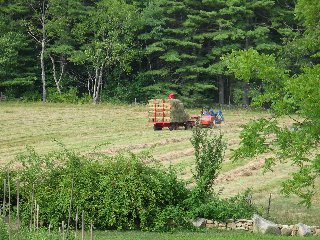
The cut hay lay in the field for a few days turning gold as it dried. The Jonathan showed up again with his tractor towing an implement called a 'tedder'. The tedder uses long steel rotating fingers to lift and fluff the hay, allowing it to dry more thoroughly. The next day, A second tractor arrived, pulling a hay rake, and yet another tractor with the baler. The pick ups were pulling two hay wagons, one a six wheeler (that's the one in the picture with my last posting below).
 Four or five hours later, the two wagons were full with nearly two hundred seventy bales. Because I have limited use for the hay this year, I told John to keep all but 20 bales, which I'll likely use for mulch. The rest was his. Typically, a field owner would split the hay roughly 50/50 with the team that hays. In the future I expect we'll use that half for our sheep.
Friday, September 08, 2006
bluebirds / hay fields
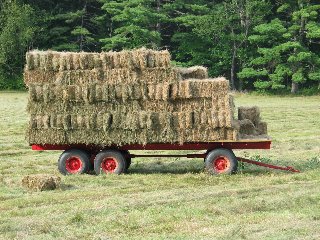
Fall comes early here, and with it the bird migrations. Ducks and geese are frequent transients, but we've been waiting for the bluebirds. They were here last year, right after we moved in, playfully picking grasshoppers and crickets out of the high grass. But this year we've cut the grass around the house, and hayed the two pastures we could easily get farm equipment into. So would they return? Not to worry, yesterday around five in the afternoon Samantha and I were out back, when a flock of bluebirds emerged from the forest and headed for the marsh down the road. Packs of ten or fifteen birds at a time flapped and coasted across the green fields, thier little orange chests giving them away. There were likely more than one hundred in all. We hope some will stay for a few days at least.
Monday, August 14, 2006
Grisha's solution to Poincare's problem
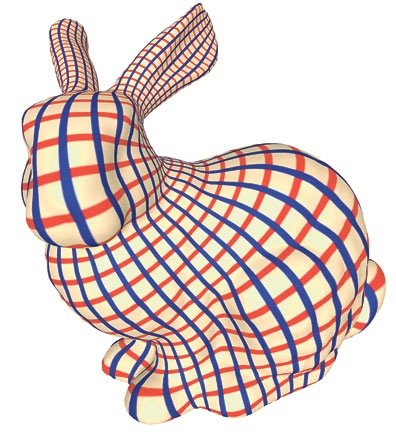
A brief article in the NYTimes about the elusive Grisha's solution of Poincare's problem, and it's implications for mathematics.
Thursday, August 10, 2006
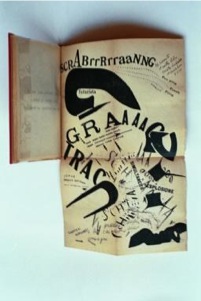
futurist visual poetry at the Getty
A Tumultous Assembly: Visual Poems of the Italian Futurists opened this week at the Getty Center. It runs through January 7, 2007.
Sunday, July 23, 2006
what I seek in a bibliography
My personal library is partially posted on librarything.com, and I've had an interesting inquiry about the Gabler Bibliography of English language wine books, Wine Into Words, 2nd Edition. I have given the book a rating of 3 stars in my library, and another lister wanted to know why not higher. I think the Gabler book is a fine book, and there is nothing else out there which approaches its usefulness. Gabler has clearly spent more time with American and English wine books than anyone I am aware of, and deserves praise for that.
If I am reluctant to praise the book higher, it is because it is too inclusive and not selective enough. In my experience, there are two types of bibliographies: one is completely inclusive, and lists every last item which ever existed on its subject (author bibliographies are typically of this sort, and should be); the second type is much more subjective, and typically relects the selections of a long term collector or scholar(s). Bibliographies in this second category might include Howes (American imprints). Printing and the Mind of Man (the history of ideas) or the Roth 101 (the photo book). In these cases the bibliographer guides the reader through a large field, toward the books which are (in the author's opinion) truly important. In both cases the bibliographies have also done much to shape the bookselling and collecting markets in their respective fields. They reflect a true connoiseurship. Gabler, who has done much to improve his book in the second edition, still includes many, many mediocre books in the list, books which serve little purpose for the collector unless one just seeks every last English language book on th subject. To me, this lessens the effect of the valuable comments Gabler has included on many entries, and moves the book toward being a checklist.
That said, the book remains very useful and I recommend it if you don't already have it.
My personal library is partially posted on librarything.com, and I've had an interesting inquiry about the Gabler Bibliography of English language wine books, Wine Into Words, 2nd Edition. I have given the book a rating of 3 stars in my library, and another lister wanted to know why not higher. I think the Gabler book is a fine book, and there is nothing else out there which approaches its usefulness. Gabler has clearly spent more time with American and English wine books than anyone I am aware of, and deserves praise for that.
If I am reluctant to praise the book higher, it is because it is too inclusive and not selective enough. In my experience, there are two types of bibliographies: one is completely inclusive, and lists every last item which ever existed on its subject (author bibliographies are typically of this sort, and should be); the second type is much more subjective, and typically relects the selections of a long term collector or scholar(s). Bibliographies in this second category might include Howes (American imprints). Printing and the Mind of Man (the history of ideas) or the Roth 101 (the photo book). In these cases the bibliographer guides the reader through a large field, toward the books which are (in the author's opinion) truly important. In both cases the bibliographies have also done much to shape the bookselling and collecting markets in their respective fields. They reflect a true connoiseurship. Gabler, who has done much to improve his book in the second edition, still includes many, many mediocre books in the list, books which serve little purpose for the collector unless one just seeks every last English language book on th subject. To me, this lessens the effect of the valuable comments Gabler has included on many entries, and moves the book toward being a checklist.
That said, the book remains very useful and I recommend it if you don't already have it.
Friday, July 07, 2006
now all of your favorite classical works in one handy volume!
The Weekly Standard has a review of a new collection of samples from the Loeb Classical library, along with a short history of the imprint. Already a resource for the inquiring "everyman" more than the classically educated scholar, the library now needs a one-volume edition to reach what passes for the educated today.
"The source of the Loeb Library's cachet may be shrouded from us in a trifling age, but that of their popularity isn't hard to discover: Along with the original Greek and Latin texts printed on the left-hand page as each book opens--texts, to say the least, of circumscribed value to most people--on the right-hand side we find crisp, unembellished English translations. The Loebs are the world's classiest crib, a trot for grownups. They are classics with a safety net. Here was an excellent innovation for those who have mentally mislaid the mastery of the classical languages they gained in schooldays. Here was also a perfect device for those who never learned them, and they make a somewhat larger crowd these days."
The Weekly Standard has a review of a new collection of samples from the Loeb Classical library, along with a short history of the imprint. Already a resource for the inquiring "everyman" more than the classically educated scholar, the library now needs a one-volume edition to reach what passes for the educated today.
"The source of the Loeb Library's cachet may be shrouded from us in a trifling age, but that of their popularity isn't hard to discover: Along with the original Greek and Latin texts printed on the left-hand page as each book opens--texts, to say the least, of circumscribed value to most people--on the right-hand side we find crisp, unembellished English translations. The Loebs are the world's classiest crib, a trot for grownups. They are classics with a safety net. Here was an excellent innovation for those who have mentally mislaid the mastery of the classical languages they gained in schooldays. Here was also a perfect device for those who never learned them, and they make a somewhat larger crowd these days."
Wednesday, July 05, 2006
Mezzo-soprano Lorraine Hunt Lieberson has died.
Never far from my CD player, Lieberson's recording of Bach's Cantatas BWV 82 and 199, has been a favorite piece of music of mine for the last few years, both a consolation and a provocation to deeper feeling. The NY Times obit today reviews her career.
"...her shattering performances several years ago in two Bach cantatas for solo voice and orchestra, staged by the director Peter Sellars, seen in Lincoln Center's New Visions series, with the Orchestra of Emmanuel Music, Craig Smith conducting.
In Cantata No. 82, "Ich Habe Genug" ("I Have Enough"), Ms. Hunt Lieberson, wearing a flimsy hospital gown and thick woolen socks, her face contorted with pain and yearning, portrayed a terminally ill patient who, no longer able to endure treatments, wants to let go and be comforted by Jesus. During one consoling aria, "Schlummert ein, ihr matten Augen" ("Slumber now, weary eyes"), she yanked tubes from her arms and sang the spiraling melody with an uncanny blend of ennobling grace and unbearable sadness."
Never far from my CD player, Lieberson's recording of Bach's Cantatas BWV 82 and 199, has been a favorite piece of music of mine for the last few years, both a consolation and a provocation to deeper feeling. The NY Times obit today reviews her career.
"...her shattering performances several years ago in two Bach cantatas for solo voice and orchestra, staged by the director Peter Sellars, seen in Lincoln Center's New Visions series, with the Orchestra of Emmanuel Music, Craig Smith conducting.
In Cantata No. 82, "Ich Habe Genug" ("I Have Enough"), Ms. Hunt Lieberson, wearing a flimsy hospital gown and thick woolen socks, her face contorted with pain and yearning, portrayed a terminally ill patient who, no longer able to endure treatments, wants to let go and be comforted by Jesus. During one consoling aria, "Schlummert ein, ihr matten Augen" ("Slumber now, weary eyes"), she yanked tubes from her arms and sang the spiraling melody with an uncanny blend of ennobling grace and unbearable sadness."
Sunday, July 02, 2006
 ferlinghetti asea
There's a nice short profile of and interview with Lawrence Ferlighetti in today's Guardian. In it he describes his life on a sub-chaser in WWII. "Any smaller than us you weren't a ship, you were a boat. But we could order anything a battleship could order so we got an entire set of the Modern Library. We had all the classics stacked everywhere all over the ship, including the john. We also got a lot of medicinal brandy the same way."
Friday, June 30, 2006
tut a tippler
It should be no surprise that the king who lived one of the grandest lives ever turns out to be a red wine drinker. I wonder if his bottles (giant clay casks I imagine) had pictures of cute animals on the labels?
It should be no surprise that the king who lived one of the grandest lives ever turns out to be a red wine drinker. I wonder if his bottles (giant clay casks I imagine) had pictures of cute animals on the labels?
the chicken diet
Our twelve hens are settling in down in the coop. The girls grow visibly larger almost daily, and have a list of new tricks. They now roost on the roof of the nesting boxes, on the ladder leading to the door (and the outside world), on the concrete block ledge that runs around the perimeter of the coop - just about everywhere but on the roosting bars I built for them. Joan Jett, the alpha hen, has taken to standing on top of the metal capped feeder, perhaps to get a better view of the flying bugs. Their diet has been of a pretty high quality lately, including arugala and brocolli rabe which had bolted, honeydew melon, snails, grasshoppers and whatever hapless bugs wander into their pen.
Our favorite remains Petunia, the little one, who is always first to greet us at the door of the coop, and who allows herself to be picked up easily, while the others require some serious chasing. As a result, Petunia gets the majority of snails.
It will be another week or so before we can release the hens into the outdoors. Hopefully they will be mostly safe, and return home without too much coaxing. Raleigh (our terrier mutt) remains intrigued by the hens but, so far, not aggressive. We'll see what happens when they meet without twisted wire between them.
Our twelve hens are settling in down in the coop. The girls grow visibly larger almost daily, and have a list of new tricks. They now roost on the roof of the nesting boxes, on the ladder leading to the door (and the outside world), on the concrete block ledge that runs around the perimeter of the coop - just about everywhere but on the roosting bars I built for them. Joan Jett, the alpha hen, has taken to standing on top of the metal capped feeder, perhaps to get a better view of the flying bugs. Their diet has been of a pretty high quality lately, including arugala and brocolli rabe which had bolted, honeydew melon, snails, grasshoppers and whatever hapless bugs wander into their pen.
Our favorite remains Petunia, the little one, who is always first to greet us at the door of the coop, and who allows herself to be picked up easily, while the others require some serious chasing. As a result, Petunia gets the majority of snails.
It will be another week or so before we can release the hens into the outdoors. Hopefully they will be mostly safe, and return home without too much coaxing. Raleigh (our terrier mutt) remains intrigued by the hens but, so far, not aggressive. We'll see what happens when they meet without twisted wire between them.
Thursday, June 29, 2006
time for a rant
Can someone please explain to me the benefit to a company in lying to its customers? In the process of renovating our house, we've had to deal with lots of suppliers, and a friend of ours who does terrific tile work has acquired the tile and fixtures for our various jobs, and done most of the installation work as well. But the suppliers he's forced to work with are incredible. We're ordering a clawfoot tub, along with all of the hardware for the shower, drain, curtain ring, etc. Two days ago we spoke to the company about the tub and fixtures. We made it clear that our top priority was availability, as I need the parts soon. We were told, "the tub and fixtures are in stock and will take two to three weeks to get to the customer." This was doable in our time framework. Yesterday, we went throught the parts list with the company on the phone, and were told that all of the parts were available and ready to ship except the tub, which is arriving at the warehouse tomorrow (Friday). Even though this was already acontradiction of what we'd been told the day before, I said ok and we placed the order.They faxed the order back, saying the tub was on a boat and would not be in the states until the middle of July, and that although the other parts are in the warehouse, it would take 2-3 weeks before those could be shipped.
Modern American companies call this a "computer mistake" or "incorrect information," but there is a simpler word for it - lying. If a customer says their main concern is a schedule, why would you even take an order for something you can't supply in their time frame? Of course, the company takes the easy way out and asks, "who did you speak to?" as if I don't know it was the same voice I was speaking to presently.
Let's reserve a special circle in Dante's hell for these idiots.
Can someone please explain to me the benefit to a company in lying to its customers? In the process of renovating our house, we've had to deal with lots of suppliers, and a friend of ours who does terrific tile work has acquired the tile and fixtures for our various jobs, and done most of the installation work as well. But the suppliers he's forced to work with are incredible. We're ordering a clawfoot tub, along with all of the hardware for the shower, drain, curtain ring, etc. Two days ago we spoke to the company about the tub and fixtures. We made it clear that our top priority was availability, as I need the parts soon. We were told, "the tub and fixtures are in stock and will take two to three weeks to get to the customer." This was doable in our time framework. Yesterday, we went throught the parts list with the company on the phone, and were told that all of the parts were available and ready to ship except the tub, which is arriving at the warehouse tomorrow (Friday). Even though this was already acontradiction of what we'd been told the day before, I said ok and we placed the order.They faxed the order back, saying the tub was on a boat and would not be in the states until the middle of July, and that although the other parts are in the warehouse, it would take 2-3 weeks before those could be shipped.
Modern American companies call this a "computer mistake" or "incorrect information," but there is a simpler word for it - lying. If a customer says their main concern is a schedule, why would you even take an order for something you can't supply in their time frame? Of course, the company takes the easy way out and asks, "who did you speak to?" as if I don't know it was the same voice I was speaking to presently.
Let's reserve a special circle in Dante's hell for these idiots.
Monday, June 26, 2006
accumulations
When we moved to a farm, with four outbuildings and enough land for a significant tire dump, we thought it would be the end of 'too much stuff'. Instead we've filled the garage barn with building supplies, a lawn tractor, tile saw, band saw, paint, and 'organic' farm chemicals. The older barn is filled with several cords of firewood, furniture we don't yet have a place for in the house, and hundreds of boxes of books. The livestock barn does finally have some livestock (12 little chickens) and more building supplies, as well as 200 banana boxes of French books in the tack room. The chicken barn is still empty, mostly because it is wet most of the time. A leaky roof and condensation on the floor cause have halted my plans for a hip gallery of avant-garde books and paper to confuse the neighbors.
To remind myself that we're not the only ones accumulating things, I periodically check the accumulation project. Click on the various images to read the story of an unusual collection.
When we moved to a farm, with four outbuildings and enough land for a significant tire dump, we thought it would be the end of 'too much stuff'. Instead we've filled the garage barn with building supplies, a lawn tractor, tile saw, band saw, paint, and 'organic' farm chemicals. The older barn is filled with several cords of firewood, furniture we don't yet have a place for in the house, and hundreds of boxes of books. The livestock barn does finally have some livestock (12 little chickens) and more building supplies, as well as 200 banana boxes of French books in the tack room. The chicken barn is still empty, mostly because it is wet most of the time. A leaky roof and condensation on the floor cause have halted my plans for a hip gallery of avant-garde books and paper to confuse the neighbors.
To remind myself that we're not the only ones accumulating things, I periodically check the accumulation project. Click on the various images to read the story of an unusual collection.
Friday, June 23, 2006
anatomy of a struggling book fair, and some suggestions
Some people have asked for a report on the Portland Book Fair, so here goes... I can't help but say that the fair seems to be on its last legs, with both dealer and customer attendance down, and none of the energy required to keep going in this difficult market.
I sold only a few dollars worth of books above the relatively inexpensive booth fee, so counting the cost of the books themselves and other expenses, I lost money. This is not an unusual occurence for me at book fairs, so my slow sales are not an indictment of the fair, but most other dealers said their sales were similar, with a few exceptions who said sales were ok.
Scouting wasn't much fun either. I bought about a dozen books, mostly cookbooks or gardening books for myself and Samantha, and one architecture book for sale. There were lots of good books there at reasonable prices for reading, but the customers weren't there. The room was pretty empty for much of the day.
Meeting new customers is always the third reason to do a book fair, and on this count, I fared better. Not only did I meet a few interesting people, but they contacted me after the fair. I take this as a good sign, and look forward to working with these folks. It will take a bit of business from these folks to make up for the two clutzes in my booth who each dropped a $700 book. Both books cracked a hinge or were otherwise slightly damaged, so I'll send them to the "junk for eBay" pile. Neither nimble customer flinched when they dropped their book, and neither apologized. Whatever happened to "you break it, you buy it"? Next book fair, I'll be putting up a "you break it, you eat it" sign.
Bitching about book fairs is a time honored activity for booksellers, and guessing the cause of a slow book fair has taken up millions of hours of our time. Good weather, bad weather, the stock market, competing television or sporting events, an illegal war, the increasingly illiterate US population... But why was this fair slow, especially in comparison to the pretty energetic Concord NH fair of just two weeks earlier? Even amongst the busy dealers and eager customers at that fair, word was that Portland is waning, lots of room was still available, and there is no energy.
This is surprising to me in that Portland as a city has really grown in the last few years. The population seems less provincial and a bit wealthier than in the past. I was interested to hear that the AIGA (American Institute of Graphic Arts) had just finished a week long annual meeting in Portland the day before the show. The arts in general are growing in profile in the region. So where were the customers?
I have no easy answer to this, but I'll be back at the fair next year, and I'll make some suggestions now about how to get Portland back on the book fair map.
1. the three sets of players with interest in the fair must all work, together or separately, to bring in more customers. The promoter, the Maine Antiquarian Bookseller Association, and the individual dealers need to actively get more dealers and more customers there.
2. local dealers not present should be encouraged to attend. Most of the larger maine open shops were note exhibiting. I'm sure they all have differing, valid reasons for not doing so, but they should personally be encouraged to attend. After all, where better to target potential customers for the fair than at the local shops in Portland, Camden, etc.
3. use the internet. The MABA has a tiny box in the corner of their website with no real info about the fair, and a link to the promoter's website, which also has limited info, as it is really aimed at dealers. MABA should create a simple page which is aimed at the public, which explains the book fair in terms of what they might find there; books in all fields, reading copies and rare books, old things and new things. Have a picture or two. Individual dealers can link to the page and email it to their customers.
4. Dealers need to take things more into their own hands. Instead of complaining to the promoter, who is busy thinking about things like tables, labor, security, etc., so we don't have to, dealers should look for ways to publicize the show themselves. Lots of newspapers up here will run anything they get in the form of a press release. Contacting your local paper with a press release is almost free of charge (maybe the MABA page I suggested could be in the form of a press release so dealers could just print it out and send it).
5. Reach out to like-minded organizations. There are organizations out there that may be inclined to help spread the word about a book fair. The Maine Publishers and Writers Alliance, local public libraries, the Maine Arts Commission, Mainepoetry.com, etc. These organizations maintain online calendars, and it is not difficult to get listed. Many orgs also have email lists they might send to.
Well, this is just a beginning. I hope others might take this list and run with it.
Some people have asked for a report on the Portland Book Fair, so here goes... I can't help but say that the fair seems to be on its last legs, with both dealer and customer attendance down, and none of the energy required to keep going in this difficult market.
I sold only a few dollars worth of books above the relatively inexpensive booth fee, so counting the cost of the books themselves and other expenses, I lost money. This is not an unusual occurence for me at book fairs, so my slow sales are not an indictment of the fair, but most other dealers said their sales were similar, with a few exceptions who said sales were ok.
Scouting wasn't much fun either. I bought about a dozen books, mostly cookbooks or gardening books for myself and Samantha, and one architecture book for sale. There were lots of good books there at reasonable prices for reading, but the customers weren't there. The room was pretty empty for much of the day.
Meeting new customers is always the third reason to do a book fair, and on this count, I fared better. Not only did I meet a few interesting people, but they contacted me after the fair. I take this as a good sign, and look forward to working with these folks. It will take a bit of business from these folks to make up for the two clutzes in my booth who each dropped a $700 book. Both books cracked a hinge or were otherwise slightly damaged, so I'll send them to the "junk for eBay" pile. Neither nimble customer flinched when they dropped their book, and neither apologized. Whatever happened to "you break it, you buy it"? Next book fair, I'll be putting up a "you break it, you eat it" sign.
Bitching about book fairs is a time honored activity for booksellers, and guessing the cause of a slow book fair has taken up millions of hours of our time. Good weather, bad weather, the stock market, competing television or sporting events, an illegal war, the increasingly illiterate US population... But why was this fair slow, especially in comparison to the pretty energetic Concord NH fair of just two weeks earlier? Even amongst the busy dealers and eager customers at that fair, word was that Portland is waning, lots of room was still available, and there is no energy.
This is surprising to me in that Portland as a city has really grown in the last few years. The population seems less provincial and a bit wealthier than in the past. I was interested to hear that the AIGA (American Institute of Graphic Arts) had just finished a week long annual meeting in Portland the day before the show. The arts in general are growing in profile in the region. So where were the customers?
I have no easy answer to this, but I'll be back at the fair next year, and I'll make some suggestions now about how to get Portland back on the book fair map.
1. the three sets of players with interest in the fair must all work, together or separately, to bring in more customers. The promoter, the Maine Antiquarian Bookseller Association, and the individual dealers need to actively get more dealers and more customers there.
2. local dealers not present should be encouraged to attend. Most of the larger maine open shops were note exhibiting. I'm sure they all have differing, valid reasons for not doing so, but they should personally be encouraged to attend. After all, where better to target potential customers for the fair than at the local shops in Portland, Camden, etc.
3. use the internet. The MABA has a tiny box in the corner of their website with no real info about the fair, and a link to the promoter's website, which also has limited info, as it is really aimed at dealers. MABA should create a simple page which is aimed at the public, which explains the book fair in terms of what they might find there; books in all fields, reading copies and rare books, old things and new things. Have a picture or two. Individual dealers can link to the page and email it to their customers.
4. Dealers need to take things more into their own hands. Instead of complaining to the promoter, who is busy thinking about things like tables, labor, security, etc., so we don't have to, dealers should look for ways to publicize the show themselves. Lots of newspapers up here will run anything they get in the form of a press release. Contacting your local paper with a press release is almost free of charge (maybe the MABA page I suggested could be in the form of a press release so dealers could just print it out and send it).
5. Reach out to like-minded organizations. There are organizations out there that may be inclined to help spread the word about a book fair. The Maine Publishers and Writers Alliance, local public libraries, the Maine Arts Commission, Mainepoetry.com, etc. These organizations maintain online calendars, and it is not difficult to get listed. Many orgs also have email lists they might send to.
Well, this is just a beginning. I hope others might take this list and run with it.
lightning, chickens
Once again it rains. We've had time enough to build an ark but have been otherwise distracted. Tuesday night our house was hit by lightning, which knocked out the phone service, killed the answering machine, modem and wireless router, and seems to have damaged the wall oven as well. I finally got the phone service back yesterday, and then the internet.
Despite the bad weather we've managed to get things done. The chickens are here. Twelve of them: six rhode island reds and six plymouth barred rocks. The barred rocks are slightly larger and much more assertive. They'll all live inside for a few more weeks before they're big enough to hit the yard. I bring them bugs from the garden and they seem to be looking forward to my visits now (chickens can be bribed).
When it's not raining, I'm residing the garage barn; a first time project for me. The garage is a warm up and training run for the rear wall of the house, which I'll side next. The second bathroom and various smaller projects continue more slowly, but are moving in the right direction.
Once again it rains. We've had time enough to build an ark but have been otherwise distracted. Tuesday night our house was hit by lightning, which knocked out the phone service, killed the answering machine, modem and wireless router, and seems to have damaged the wall oven as well. I finally got the phone service back yesterday, and then the internet.
Despite the bad weather we've managed to get things done. The chickens are here. Twelve of them: six rhode island reds and six plymouth barred rocks. The barred rocks are slightly larger and much more assertive. They'll all live inside for a few more weeks before they're big enough to hit the yard. I bring them bugs from the garden and they seem to be looking forward to my visits now (chickens can be bribed).
When it's not raining, I'm residing the garage barn; a first time project for me. The garage is a warm up and training run for the rear wall of the house, which I'll side next. The second bathroom and various smaller projects continue more slowly, but are moving in the right direction.
Monday, June 05, 2006
two weekends in New Hampshire
Two weekends, two weeks apart, and nothing in common but rain.
Samantha and I spent a Saturday driving through last month's torrential rain in order to attend the New Hampshire Sheep and Wool Festival. Held on the grounds of State Fair, the event was populated with soggy sheep, llamas, apalcas, goats, rabbits and their relative enthusiasts. Appropriately, the whole place smelled like wet sheep. We were there to get an education in the wooly creatures, perhaps even pick a breed that will eventually trade a roof over their heads for mowing our lawn. Unfortunately, some of the sheep exhibitors must have stayed home, and some of the breeds we were excited to see weren't present. we cna only hope that the weather for Maine's upcoming Fiber Frolic (next week) will be better.
I returned to New Hampshire yesterday in search of a quarry with which I feel a bit more comfortable - books. The book fair, in Concord NH, was really pleasant. Just one day, a full room of dealers (most of whom I don't know or see elsewhere), and some good books to buy. Some new purchases included: a monograph on Cobra artist Pierre Alechinsky, inscribed by the author to gallery owner Xavier Fourcade, a rare Jean Tinguely exhibition catalogue, an inscribed book by poet Harvey Shapiro, and a very rare work of Paul Claudel, the first separately printed edition of his Ideogrammes Occidenteaux, published in an edition of 200 and rarely seen. A few other oddball food and famr books rounded out the purchases. It was also nice to see some friendly colleagues: Dave and Jenny Ritchie, John Waite, Greg Powers, Jim Arsenault, and others. In all, a good day.
Two weekends, two weeks apart, and nothing in common but rain.
Samantha and I spent a Saturday driving through last month's torrential rain in order to attend the New Hampshire Sheep and Wool Festival. Held on the grounds of State Fair, the event was populated with soggy sheep, llamas, apalcas, goats, rabbits and their relative enthusiasts. Appropriately, the whole place smelled like wet sheep. We were there to get an education in the wooly creatures, perhaps even pick a breed that will eventually trade a roof over their heads for mowing our lawn. Unfortunately, some of the sheep exhibitors must have stayed home, and some of the breeds we were excited to see weren't present. we cna only hope that the weather for Maine's upcoming Fiber Frolic (next week) will be better.
I returned to New Hampshire yesterday in search of a quarry with which I feel a bit more comfortable - books. The book fair, in Concord NH, was really pleasant. Just one day, a full room of dealers (most of whom I don't know or see elsewhere), and some good books to buy. Some new purchases included: a monograph on Cobra artist Pierre Alechinsky, inscribed by the author to gallery owner Xavier Fourcade, a rare Jean Tinguely exhibition catalogue, an inscribed book by poet Harvey Shapiro, and a very rare work of Paul Claudel, the first separately printed edition of his Ideogrammes Occidenteaux, published in an edition of 200 and rarely seen. A few other oddball food and famr books rounded out the purchases. It was also nice to see some friendly colleagues: Dave and Jenny Ritchie, John Waite, Greg Powers, Jim Arsenault, and others. In all, a good day.
Subscribe to:
Posts (Atom)