Saturday, October 15, 2005


a very hard-to-see rainbow, during a break in last week's rain, across the back yard. Posted by Picasa

looking down into the kitchen from the little 'cathedral' ceiling Posted by Picasa

the bathroom floor, with new plumbing Posted by Picasa

the shower wall (with water on the chimney stack) Posted by Picasa
it's all destroyed

We've finally hit the point beyond which demolition starts to slow, and reconstruction picks up. The master bathroom is stripped to the studs, with the new plumbing roughed in. Mike should be laying down the subfloor for tiles, and the wonderboard for the shower wall foundation. It's a good thing he didn't start when he was scheduled, as the recent heavy rain has revealed a leak around the bathroom vent and the woodstove chimney, which rises behind the shower wall. In another week, it would all be sealed up, and we'd likely have to pull some of it out in the future.

The kitchen is significantly more destroyed than during my last post. The ceiling is entirely torn down, and all that remains is the old cast iron sink, which is too heavy to move by myself.

Samantha has been painting away (interiors only during this wet season), and we both hope to put down a new floor in the den next week. After that, we'll have lots of molding to put in, having removed much of it in the demolition.

Monday, October 03, 2005


potential cathedral ceiling Posted by Picasa

would you trust this man with your kitchen? Posted by Picasa

kitchen destruction Posted by Picasa
demolition man

Demolition, which seems like the simplest, most primitive, part of reconstruction, is actually quite a challenge. Removing a wall or ceiling, pipes or electrical lines generates new problems and possibilities at every turn. With the master bathroom fully demolished, I turned my attention to the kitchen. But after two days of Sawzall and sledgehammer work, it's down to the studs and plywood. All except the ceiling, which we've decided to remove entirely, revealing a small extension of "cathedral ceiling" above the center island and counters.

Deconstruction proceeds on the living room outside wall, where there will be a new pair of doors and a matching window, replacing the rotting wood siding and porthole-like octagonal window.

Thursday, September 29, 2005


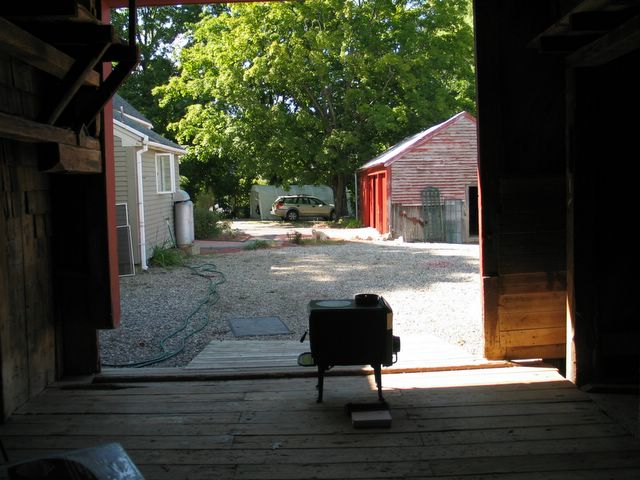
woodstove in the barn Posted by Picasa

newly painted garage doors Posted by Picasa

Dad weeding the hedgerow Posted by Picasa
folding chairs

It's a shame I can't find or make more time to blog these days. Things are happening at such a quick pace. Been spending much of my time demolishing a bathroom down to the studs, and preparing a kitchen for similar destruction. In between there's talking to contractors, chimney sweeps, tractor salesmen and loggers (about cord wood). A bit of a change from Prospect Heights, Brooklyn.

Samantha and I are glad we opted for Maine where we have so many skilled friends, instead of Columbia County or Vermont where we know few people. The bathroom tilework is in the able hands of our friend Mike G., while the kitchen cabinets are being designed and built by Dave our source for occasional free sailing and the owner of Bullhouse Boat Works, a heritage craft wooden boat building business. We assume our kitchen will float when it is complete. Having knowledgable people to bounce things off of is an indispensible plus.

Although we've spent thousands on new tools in the last month, our most precious purchase was the two folding chairs which remain almost all of the furniture in the new place (everything else remains in storage). For lunch, or when we're just too tired to continue at the end of the day, we drag the chairs to the edge of the "patio" (read gravel) and look out at the field. The past two days have brought a change in birdlife in the trees and hedgerows, and a flock of bluebirds have arrived, diving into the grass for crickets and who knows what else. There were high winds today, and while we sat eating our lunch a cracking noise came from the forest as a tree laid itself down.

Sunday, September 11, 2005


barns one and two. Posted by Picasa

looking from the pasture into the hayfield. Posted by Picasa

the farmhouse Posted by Picasa

Friday, July 29, 2005

a new home in Maine

My posts have been infrequent and, for the most part, off topic for quite a while now. Sorry for the paucity of book related info. I hope you'll understand. Samantha and I have been planning our move for quite a while now, and after the sale of our place here in Brooklyn, things accelerated nicely. To add fuel to the fire, we found a place in Maine, made a bid this past Monday, and spent the last week gritting our teeth hoping that another bidder wouldn't beat us to the punch. We'll we're in contract now, and assuming the inspections go well, we will be closing on the 25th of August.

The new home is a mid 19th century farmhouse, with some later day renovations, and three attached barns, all on 18.5 acres of mixed farmland and forest. I fully expect that in no time at all, we will have an operational vineyard (for late harvest wines, naturally), bees, truffles, peacocks, goats, vicuna, alpacas and whatever other ridiculously impractical ideas we can come up with. More news soon.

Sunday, July 10, 2005

farm dreams

Been getting a bit carried away lately - reading more books about farming, daydreaming about erosion, and viewing tractors for sale on eBay. Our move still seems a long way off, but seems more real all the time.

Thursday, June 23, 2005

soil & soul

I recently made a reference to lots of good reading - a trend which has thankfully continued. Lately, my mind and reading table have been occupied with books about food, both eating and growing. This week I digested Scott Chaskey's This Common Ground, an ode to organic farming by an experienced farmer, a talented poet and a patient man. Chaskey charts the benefits to soul and soil and in this description of the seasons on Quail Hill Farm CSA in Amagansett, NY which he ran for many years. My subway reading has been Waverley Root's The Food of France. Root's book, which is arranged as a travelogue of sorts, loudly celebrates the local forces which create cuisine (geography, politics, culture, etc.). Originally published in 1958, the book was claiming the importance of terroir for food and and wine long before organic farming was a necessary reaction to the despoilation of our farmland by "modern farming methods". Compiled three decades later, Andries de Groot's collection of essays, In Search of the Perfect Meal echoes many of Root's ideas about the important of location in formation of cuisine. Samantha was wonderful enough to get me two books of Hugh Fearnley-Whittingstall - The massive and thorough River Cottage Meat Book, and his seasonally based farm cookbook, The River Cottage Year. I've only begun to cook from the River Cottage Year, trying the lettuce risotto, rhubarb trifle, and a few others, all to great satisfaction. I'm slowly plodding through the Meat Book in the hot weather, hoping for the fall, when the idea of a few hours over a hot stove won't seem so difficult.

Saturday, June 18, 2005

summer catalogue - parts 1&2

After much cataloging and scanning, I've finally finished both parts of my summer catalogue. It's arranged alphabetically, with part 1 covering the first half of the century, and part 2 the second half. While much of the catalogue is given over to the historical avant-gardes, there are many items in the fields of design, architecture, literature, modern thought and culture. I'll be integrating the catalogues into my website soon.

Sunday, June 12, 2005

June slides by

This has been an impossible month, with Samantha and me putting the apartment on the market and trying to imagine just what is next. My reading has taken a turn toward the bucolic, with lots of food related books (both old and new) making it to the bedside table. More about those books later. We've both been separately grappling with the idea of writing, and imagining that our new rural surroundings may aid in that process. Of course, this is a fantasy. Samantha, though has been working on it all along - her blog has become more than a dumping place for the daily brain clutter, or a rehash of interesting links. It's really an investigation of the process of baking, and of becoming a baker, from the inside out. What's more, she's developing readers, well beyond the well-wishing friends and relatives that form every (well most) writers' first audience. I'm just a bit jealous.

I've been wrapped up in the appraisal of the archive of a well-known horror writer. In fact a very nice, very literary chap. This constant exposure to the process of writing, seems to be having an effect on the way I organize my thoughts. Certainly, it helps to demystify the workings of the writers' mind when you see the constant revising, the complete but discarded novels, the thousands of pages written before recognition reveals itself. When craft is laid out in front of you like this, it seems more possible, but much more work.

Friday, May 20, 2005

While the blogging has been on hiatus, it's been a month of great reading. Last night finished Zbigniew Herbert's King of the Ants, a retelling and extension of a mythological stories. The narrator assumes an attitude of amused consideration, filling in gaps in the original tales, or following incomplete threads to a previously unspoken conclusion. While the book hasn't the sheer brilliance of Barbarian in the Garden, it still provides a peak into the swirl of ideas which is Herbert's mind.

Tuesday, May 03, 2005

time to resume

It's been more than a month now without my laptop, and thus, no blogging. Events come and go, reviews are waiting, and generally work is piling up, but not to worry, blogging is an entirely voluntary activity!

Friday, April 01, 2005

it's spaghetti harvest time

For one of the great hoaxes in history, look to the British. The august BBC ran a piece on a news program called Panorama, in which a highly-respected journalist, Richard Dimbleby, delivered with absolute seriousness a story about the Swiss Spaghetti Harvest. Spaghetti was relatively unknown at that time in the U.K. and viewers began calling the BBC asking how they could grow their own spaghetti tree. The BBC encouraged caller to place a stick of spaghetti upright in a can of tomato sauce. Here's the transcript:

It isn't only in Britain that spring this year has taken everyone by surprise. Here, in the Ticino, on the borders of Switzerland and Italy, the slopes overlooking Lake Lugano have already burst into flower at least a fortnight earlier than usual. But what, you may ask, has the early and welcome arrival of bees and blossoms to do with food? Well, it's simply that the past winter, one of the mildest in living memory, has had its effect in other ways as well. Most important of all, it's resulted in an exceptionally heavy spaghetti crop.The last two weeks of March are an anxious time for the spaghetti farmer. There's always the chance of a late frost which, while not entirely ruining the crop, generally impairs the flavor and makes it difficult for him to obtain top prices in world markets. But now these dangers are over and the spaghetti harvest goes forward.

Spaghetti cultivation here in Switzerland is not, of course, carried out on anything like the tremendous scale of the Italian industry. Many of you, I'm sure, will have seen pictures of the vast spaghetti plantations in the Po valley. For the Swiss, however, it tends to be more of a family affair. Another reason why this may be a bumper year lies in the virtual disappearance of the spaghetti weevil, the tiny creature whose depredations have caused much concern in the past. After picking, the spaghetti is laid out to dry in the warm alpine sun. Many people are often puzzled by the fact that spaghetti is produced of such uniform length but this is the result of many years of patient endeavor by plant breeders who have succeeded in producing the perfect spaghetti.And now the harvest is marked by a traditional meal. Toasts to the new crop are drunk in these boccalinos. And then the waiters enter bearing the ceremonial dish and it is, of course, spaghetti, picked earlier in the day, dried in the sun, and so brought fresh from garden to table at the very peak of condition. For those who love this dish, there's nothing like real, home-grown spaghetti.

- thanks to Manhattan User's Guide for the info.

Thursday, March 24, 2005

my reading table

Recently finished reading Anatole Broyard's Kafka was the Rage, a Memoir of Greenwich Village. He manages to single out various elements which made the world a very different place at that moment. While the art of the moment didn't grab him, the strange nature of relationships between men and women, and men and men, did. Broyard's descriptions of NYC's citizens beholden to what they read as much to their actual existences were enticing if exagerated.

Currently in the middle of M.F.K. Fisher's little book, A Cordiall Water, a slight survey of healing concoctions througout history.
plunder to return to southern Italy

"Wartime loot may summon up images of art treasures plundered by the Nazis from persecuted Jews, rather than a rare book acquired by the British Library from a respectable English army captain.

But now a 12th-century missal which has formed part of the library's collection since 1947, must be returned to its home city of Benevento, in southern Italy, according to a ruling.
It is written in the rare Beneventan script, unique to the region, which flourished from the 8th to the 13th centuries.

The ruling marks the first time that an artwork plundered during the second world war and held in a British national collection will be returned to its rightful owners."

- from a report in the Guardian.

Tuesday, March 22, 2005

plus Dumas, s'il vous plait

'The Knight of Sainte-Hermine', a previously unknown novel by Alexandre Dumas, of Three Musketeers fame, has been discovered in the French National Library. Le Figaro reports the 900 page work will be published in France in June.

This comes on the heels of a survey of designed to find the 'Greatest Frenchman of All Time, which neglected to include Dumas, Sartre, Belmondo, and others. I was pleased, however, to see that fiesty food and anti-globalisation crusader Jose Bove made the list.

Wednesday, March 16, 2005

MET acquires Gilman collection

The Gillman Paper Company collection of photographs is going to the Met. It is likely the most important collection of photography in private hands, and its arrival at the Met makes the museum one of the most important institutional photography collections in the world.

Sunday, March 06, 2005

Just when I thought it impossible to start another collection of my own, I've been making piles of cookbooks on the floor. Cookbooks are nothing new to our home, as Samantha (a professional pastry "cook" - she won't let me use the "chef" word), has quite a collection, the growth of which I've been very involved with. But a recent trip to Maine and Doug Harding's shop in Wells, a perennial stop on our visits north, drove home to me how engaged I've become with these shop manuals for the kitchen. I was rooting in the art and poetry sections, while Samantha hit the cookbooks. She emerged happy with a small pile of books by Pierre Franey and others. But later when I viewed the cookbooks, something broke inside my brain, and I started pulling titles off the shelf for myself.

Later when we compared stacks, I realized that we saw two entirely different things in our quarry: she sought books for information she could use (although living with a bookseller she understands the aesthetic and other qualities of books), while I sought pieces of history. History in the information (about chefs, restaurants or even entire cuisines gone by), and history in the printed artifact. My finds included Pelleprat's L'Art Moderne Culinaire in a 1930's dust jacket, Rene Coste's monumental two volume work on coffee production, Paul Elliot and Luis Quintanilla's drinking manual, 'Intoxication Made Easy', and best of all a first of Elizabeth David's first book, 'A Book of Mediterranean Food"a book which British bookseller Nigel Williams call "an early example of gastro-porn'. Some other recent acquisitions include the first Zen Macrobiotic cookbook (I won't be using those recipes anytime soon) and a nice first of the most handsome bar book ever - the Savoy Cocktail Book.

Getting hungry now - must eat!

Wednesday, February 23, 2005

Cabrera Infante dead at 75

The Guardian reports that Guillermo Cabrera Infante, the greatest Cuban novelist of his generation, has died at 75.

"In 1967, he published Tres Tristes Tigres (Three Sad Tigers), one of the classics of the "boom" in the Latin American novel. Its playful tongue-twisting title sets the tone for this completely original, elliptic and difficult novel, "a celebration of Havana nights", as he put it. Cabrera reinvented a magical 1950s city, packed with music, sex, dancing, sweat and conversation. His master was James Joyce (J'aime Joys, as he said in one of his wonderful polyglot puns), and Three Sad Tigers has multiple narrators, scant plot and a middle section like something out of Finnegans Wake.

Cabrera's wit, imagination and brilliant language hold together the book, which culminates in a long conversation that ties up most of the threads. Its themes are those that recur throughout his writing: sheer joy in physical pleasures and in the human contact of jokes and anecdotes. Cabrera believes in seducing and entrancing his readers. Most critics resort to music to express the book's quality: bursts of solo sax, vibrant duets and long, melancholic interludes." from today's Guardian obit."


Greenwich Village Antiquarian Book Fair

This weekend, Friday through Sunday, you can find me at the Greenwich Village Antiquarian Book Fair, a long-running benefit for p.s.3 here in NYC. It's a pleasant fair, with a bit of the feel of book fairs from times gone by. There's a list of some of the items I'll be bring to the fair at my bookselling website. If you're in the area I hope to meet you.

Tuesday, February 22, 2005

lives of writers and my own

Once again there's been too much time between entries. But I've been to Fayetteville, AR and the Turks and Caicos in between so I'll pretend I have an excuse. The work in Arkansas was the second and final phase in a cataloging job for the appraisal of a major literary archive. The work is quiet but focussed, and it's always interesting to see how immersion in the daily creations of writers, artists and other thinkers can impact my own ideas about a well-lived life. One thing that struck me while working was the need of this writer for both extreme isolation and, simulataeously, for true companionship. I found my self longing for my little place in Maine, no tv, a competently equiped kitchen and my library. At the same time I admired the deep literary friendships expressed in his correspondence, the ability to communicate in relative honesty about writing, struggles, politics and of course, sex and sustenance.

The isolation is relative, although I find myself leaning more and more toward a severe form of isolation which may involve moats. A few acres will likely do just fine. On the literary companionship front, all of my efforts to develop literary correspondences with my hard reading friends generally never get off the ground or quickly stall for the usual reasons: lack of time, other diversions, conflicting schedules. Another thing I've noticed is that none of us has the same, or even a remotely similar, reading list. Samantha and I both read fiction and food history books, but it's rare that we have both read the same titles. Dennis the poet and I both spend many hours reading verse, but it may be only one book out of ten or more that we both digest. Is this a modern condition? Or is it just an illusion that in previous eras there was a good chance that reading was a more commonly shared experience?

Thursday, February 10, 2005

more Mondovino vs. Robert Parker

In a wonderful essay in the London Review of Books, Steven Shapin charts the history of discriminating taste, from Sancho Panza, through David Hume and Brillat-Savarin to the current state of wine connoiseurship. He sees pitfalls in the adherence of much of the world to Robert Parker's 100 point system for rating wines, and more danger in the world's desire to supply wines which rank highly in the system. Should the nose of one man (Robert Parker) have so much power? Enter Jonathan Nossiter, whose three hour documentary, Mondovino, takes on globalization within the wine industry, and makes a serious case for the true local craft of winemaking, once the province of men (and women) in love with their own few acres of dirt, sky, and vines.
mcmurtry to shutter bookedup because archer city is boring

"I like to go out at night," he said. "I like to sit in a nice room and look at beautiful women. I don't want to just sit on my back porch drinking scotch, and there isn't much more to do in Archer City."

Well, bookselling has never particularly been a portal to the proximity of beautiful women, and many of us take solace in the attractive bar and waitstaff of bars and restaurants nearby our shops, homes and bookfair locations. Our sour, disappointed faces, distorted by another day spent at another slow bookfair can suddenly brighten as dinner plans materialize. Thoughts of tasty food and a tastier coat check girl can eliminate thoughts of sore feet and stupid questions from "customers". I can fully appreciate McMurtry's need for some scenery.
pain, lobsters, and David Foster Wallace

Norwegian scientists have now definitively (we can hope) demonstrated that lobsters, and other invertebrates, feel no pain. This puts the crimp in DFW's review of the Maine Lobster Festival, which appeared in the August issue of Gourmet. Thanks to The Elegant Variation for the heads up on the Guardian article.

Tuesday, January 25, 2005

a stolen book now in dispute

A dispute between the German government and a St. Louis bookseller has risen over a rare book of 16th century drawings and etchings. As much as booksellers are frequently described as having less than perfect morals, I don't personally know any dealers who wouldn't recognize that it is abundantly clear that the book belongs back in the collection it was stolen from (not by the dealer). The dealer did a bit of homework, and seems to have originally operated in good faith, but it doesn't matter in the end. The book was stolen, and should be returned. (thanks to bookslut for the link)

Friday, January 21, 2005

woodcut masterworks at the Grolier Club

A current exhibition at the Grolier Club, NYC, displays early woodcut illustrated books collected by Lessing J Rosenwald. The 15th and 16th century books, include works by Durer, Urs Graf and Hans Burgkmair. The exhibition is up through February 5th.

Sunday, January 02, 2005

mondovino

Can't wait until March when 'Mondovino', Jonathan Nossiter's documentary about winemaking and globalisation comes to America. Nossiter's 2.5 hour paean to small vineyards and local methods has already struck a nerve with some of the large scale producers, and should continue to do so as the film gets wider distribution. It is perhaps in winemaking that the idea of "local is best" is most evident. Fine wines have almost always been identified by region and sought by educated drinkers and collectors who have known that two vineyards on opposite sides of a river valley can create radically different qualities of wine. So why now the push for homogenization? We'll see what Nossiter says, but my own guess is that the emphasis on varietals in naming (Merlot, Chardonnay, etc.) has conspired with efforts to open new markets to create global consistency of the characteristics (as defined by whom?) for those grapes. Connoiseurs will still follow terroir, which seems to be staging a comeback on its own, but in the meantime how many wonderful vineyards will be pulled up to be replanted with grapes whichcan command higher prices on the world market? Let's hope the forces for small will win out in the end.
Jared Diamond's Collapse: How Societies Choose to Fail or Survive, is shaping up to be one of the more talked about non-fiction titles of the beginning of the year. First a lengthy positive review in the New Yorker, followed by a half-page Op-Ed in the NYTimes. Now the title has been included in the Guardian's list of literary highlights of the coming year.

Wednesday, December 29, 2004

more on Susan

"We live in a culture in which intelligence is denied relevance altogether, in a search for radical innocence, or is defended as an instrument of authority and repression. In my view, the only intelligence worth defending is critical, dialectical, skeptical, desimplifying." quoted by Steve Wasserman in his obituary.

Quotes, interviews and excerpts are available at wood s lot.

Tuesday, December 28, 2004

"be serious, be passionate, wake up!"

Susan Sontag - novelist, critic, public intellectual and watchdog for the oppressed - passed this morning, after a long, second bout with cancer.

In the summer of 2000, I had an opportunity to meet and spend some time in the orbit of Sontag, as I was cataloguing for the company performing an appraisal of her personal archive and library, (which was eventually purchased by UCLA). For nearly six weeks, I spent my days in Sontag's office or home, quietly cataloguing, while around me her life whirled. Alfred Brendel would like to have dinner; Chinese writer Gao Xingjian was arriving from Boston on the Chinatown bus; new books piled up by the dozens (many were immediately donated to her assistants or others); Nadine Gordimer was on the phone... And all this time she was sick with cancer. She was a gracious host, inviting me to join her for lunch which she often shared with them in the kitchen. She was also disarmingly human for someone I had come to think of as an intellectual superhero (especially given that most of the other superheros seemed to be missing). My life at the time was not an easy one. I was entering the divorce process at the time, and I remember Susan giving me a grandmotherly hug the day she found out why I was uncharacteristically sullen.

My time spent with her archive and library, which documented her intellectual pursuits from a very young age, and the living example she lived in front of me was enough for me to recommit to the life of the mind, even as a simple bookseller.
sidewalk Socrates

The NYTimes Magazine includes Sidney Morgenbesser in it round up of year-end obits.

"Not since Socrates has a philosopher gained such a reputation for greatness while publishing so little of note. Certainly no one else shaped so many seminal thinkers while leaving behind almost nothing in the way of major doctrines or ideas. ''Moses published one book,'' Morgenbesser pleaded in his own defense. ''What did he do after that?'' "

shredded reputation, worst sex, scrupulous blurb...

Thanks to Jessa at Bookslut for the link to the John Dugdale's Literary Awards of the Year at the London Times. Anthony Powell wins the "Most shredded reputation" award:

Most thoroughly shredded reputation"As a novelist, Anthony Powell had to contend with obvious disadvantages. He had no ideas. He was incapable of conveying deep feeling. He knew about only a tiny upper stratum of English society. He was Waugh minus the wit, the poison, the torment and the genius . . . Powell was a colossal snob and not very bright. The fact that his snobbishness was a cry for help did not make its manifestations any more winning." John Carey reviews Michael Barber's Anthony Powell: A Life, The Sunday Times

Sunday, December 19, 2004

a thank you

It's about time I thanked some of the bloggers out there who have been sources of information, and more often, inspiration to keep on doing this. My first expereince with a blog was The Morning News - I know, not technically a blog, but it provided a portal to many of the those which became my daily reading. My daily reading consists, on and off, of The Elegant Variation, Blog of a Bookslut, Language Hat, and Pepys Diary. Other frequent dips were made into The Millions, Anthem Book Blog, Eternal Recurrence,

My favorite gardening blog is Horticultural, where you can find a link to the timely Mistletoe Blog. My vote for food blog must go to my wife Samantha's Slouching Toward Ganache which records her travails as a career changer entering the world of pastry. I'm also partial to SauteWednesday, Megnut, Chocolate & Zuchini and The Daily Olive.


a home universal library

In today's NYTimes' Week in Review, Alberto Manguel places new efforts of Google in the context of the quest for 'universal knowledge'. People who know me through my bookselling, think of the avant-gardes as the core of my collecting (or selling) interests, but a few friends know my own library, which lives in an apartment carved out of an old post-and-beam barn in Maine, is really my humble attempt to establish a Library of Alexandria for myself. It's the antithesis of my avant-garde inventory; scholarly editions of the works of thinkers from cave painting to modern Portuguese poetry, with major sections of classical philosophy, medieval history, early technology and odd books on small facets of human activity like bee keeping, automatons, or monks and viniculture. For years this library has grown in fits and starts, usually dependent upon my proximity to a great general shop. Powell's in Chicago (Hyde Park), The Brattle in Boston and the Strand have contributed to it greatly at various times. I have yet to assemble the whole library in one location, and look forward to doing so one day, perhaps after we move to the Hudson Valley this coming year. The library remains beyond my ability to read in the time remaining on my life clock, and there are numerous books in languages I have no plan to learn, so why have it at all?

There's been an awful lot of handwringing going on at the booksellers' newsgroups lately about Google's plans to place online books from the collections of major research libraries. Some think this is the last straw for reading culture as we know it, and expect their trade to dry up as well, which is ridiculous. Art is not what it used to be, and yet the trade in art from previous centuries is more brisk than ever. And as we saw the daily use of low-brow booze and tobacco products wane in the last two decades, the demand for quality wine, liquor and cigars has grown exponentially.

Sunday, December 12, 2004

Mann's Magic Mountain shuts its doors

The Valbella clinic is closing its doors, the last of the once numerous clinics in the Swiss Alpine resort town of Davos, built to treat the victims of Tuberculosis. Thomas Mann's Hans Castorp found refuge here, deciding to stay although he had only come as a visitor.

Saturday, December 11, 2004

Jackson Mac Low dies at 82

Fluxus founder, poet, performance artist and composer Jackson MacLow has passed at 82. With LaMonte Young, MacLow was the editor of the wonderful Fluxus Anthology (1963).
renunciation

AS Byatt discusses Goethe in the Guardian. The bit that really got me was this one:

"The Wanderjahre, or (literally) journeyman years, follow the fate of Wilhelm, who in Goethe's earlier narratives, Wilhelm Meister's Theatrical Mission and the revised Wilhelm Meister's Apprentice Years, was concerned with self-discovery through the theatre, and also with the theatre as a means of moral and social cultivation. The theatre, in the world of the young hero, is the place where the bourgeois, who is normally only concerned with getting and spending, can acquire the aristocratic possibilities of "being" and "appearing". "

Do we have a mechanism today which serves that same purpose? Which can at least momentarily raise the bourgeois above the concerns of "getting" and "spending"? What could that be?

Byatt also draws the connection between Goethe and Sebald's masterwork, The Emigrants.

Wednesday, December 08, 2004

French winemakers protest

French wine consumption is less than half of what it was in the 1960's, and coupled with falling exports levels, competition from Latin America and Australia, and high levels of production, the situation is dire. Protesters are blaming the government (a French pastime), and targeting the national anti-drinking and driving campaign.

Thursday, December 02, 2004

a year-end miscellany

I'm currently offering a catalogue of year-end miscellany. The list includes art, literature, ideas and photography. Over 150 items, offered at 25% off the price listed. Download the entire catalogue here. Thanks for looking.

Saturday, November 27, 2004

"... a continuous parallel between contemporaneity and antiquity"

Hilton Kramer reviews the Adolph Gottlieb show at Pace Wildenstein, and reminds us of the indebtedness of the Abstract Expressionists to the literary modernists who came before them. These modernists, Joyce and Eliot particularly, had themselves turned to the ancient Greeks, and it was this interest in the mythical which shows itself in the work of Gottlieb.


textbook warning labels

While I'm normally repulsed by any use of stickers on/in books, this one ain't half bad. Colin Purrington, Assoc. Professor at Swarthmore, has created a handy, printable set of warning stickers to be placed on scientific textbooks. Collect 'em all! Protect your neighbors!

Wednesday, November 24, 2004

yhe view from up North

Thanks to the ArtsJournal for the link to Vinay Menon's excellent screed in the Toronto Star. Menon attacks the prudishness which is enveloping our country, and the mighty corporations we thought invincible which are now folding under the pressure of a crackpot minority.

Elaine Showalter on Wolfe

"true to form, Wolfe's latest novel is bitchy, status-seeking, and dissecting -- and this time, unfortunately, numbingly juvenile."

Elaine Showalter, in the Chronicle of Higher Education, taking to task Tom Wolfe's I am Charlotte Simmons. Showalter includes some interesting comparative criticism of various forms of the "campus" novel.


Tuesday, November 23, 2004

Holderlin once again revised

Should the world listen more to the great Romantic poets? Michael Hoffman, in his Guardian review of the new 4th edition of Michael Hamburger's translation of Friedrich Holderlin's poetry seems to think so. At least the themes seem necessary today:

"youth, love, friendship, generation conflict, sibling relationships, world- and self-intoxication (to coin a couple of rather Germanic-sounding notions), a revitalised appreciation of the classics, idealist philosophy, revolution, spirituality and the death of religion, a volatile interest in the inner and outer world (all sorts of fads and "isms"), a proclivity for associations, amalgamations, movements, new magazines, publishing ventures and experiments in social living."

Holderlin has been a favorite of mine since the early 1980's, when I discovered one of Hamburger's previous editions of Poems and Fragments. As a college student, I was drawn, of course, to the tragic life of the poet; a sad youth, failed loves, mental illness, and finally 36 years of solitude spent writing in the tower of a supporter. While my friends read Rilke, I read Holderlin, only later finding Rilke for myself. Many years hence, following a divorce and a move to relative solitude in Maine, I stumbled across a first edition of Hamburger's translation, and began rereading. Poems and Fragments, alongside Pessoa's Book of Disquiet, became a clear stream I could dip into when necessary, and has remained so since.

Sunday, November 21, 2004

more delays

More than a month has passed since my last post; an inexcusable length of time in the blogosphere, so I apologize for the delay to anyone who might care. I spent six weeks fighting an unnamed (until late in the game) ailment which was eventually diagnosed as Lyme. Now Lyme had never been something I took very seriously, having grown up around dogs and horses and the ever present threat of ticks. I also know scores of people who have contracted Lyme and only exhibited minor symptoms. Not me. The symptoms were many and disabling, at least temporarily. So I now return, a bit lost as to where I should start.

First, a thank you to Jay at Anthem Book Blog for posting a link to his book blog. I'm still struggling with the html with creating a links bar on casa malaprop, and promise to reciprocate as soon as I figure it out.

I should at least offer a small bit of thanks to the internet, which allowed me to continue to do some business while laid up in bed or on the couch for so long. I managed to sell a handful of titles, including some signed firsts of Jacques Derrida (after his passing), my inscribed copy of Hans Helm's Fa : m' Ahniesgwow, an experimental music and text piece from 1959 based in part on Joyce's Finnegan's Wake. Some lesser sales rounded off a month of just barely getting by.

My first foray back into the bookselling world was a day at Sotheby's, attending the second part part of the Maury Neville sale of Modern Literature (I skipped the late afternoon session of Modern Detective Fiction - not my thing). The highlights, in terms of money, were predictably Hemingway items, including the For Whom the Bell Tolls, inscribed by H. to his wife, and a large group of letters, both fetching over $300k each including the buyer's premiums. Not surprisingly, most of the aggressively priced Kerouacs failed to sell, and some authors saw their stars dim further, notably James Jones. Friends of mine picked up some quality sleepers, including an inscribed, limited first of Del Miño al Bidasoa by Nobelist Jose Camillo Cela, and an inscribed copy of Sartre's Huis Clos, both purchased for reasonable prices.

Unfortunately, a death in my extended family is keeping me from the Boston Book Fair, which I had intended to visit, hoping to do a bit of business on the side and perhaps to find some unusual items for purchase. Oh well.

Thursday, October 14, 2004

pardon the delay

There's nothing like a book fair to take the vinegar out of me. The Autumn New York Antiquarian Fair was this past weekend, and between preparations, the fair itself and a required time to deal with the necessarily ensuing depression, I've missed opportunities to post on the Nobel Prize, Jacques Derrida's passing, the National Book Awards nominees and the fair itself. Also missed John Banville's review of Jose Saramago's 'The Double' in the NYTBR, which itself should have been cause for at least two posts, being that they are two of my favorite living writers. Methinks it better to move on and not look back.

The book fair itself was a rather grey affair, which has been all to frequently the case of late. The customers are pretty much the same faces we always see, the flurry of dealer buying and selling which used to precede the shows (and which, for some dealers, made up the bulk of their sales) has given way as a dearth of sales leads to a lack of desire for new stock. There are many, many reasons for the decline in the market for most rare books, and sometime soon I'll tackle that question here, but for the time being let's just blame the internet, a declining level of literacy, price inflation in some segments of the market, a treasure hunt mentality of the general populace fed by eBay and the Antiques Roadshow, and once again, the internet.

Tuesday, October 05, 2004

Nobel speculation

The Times' Alan Riding mulls over some possible contenders for this years Nobel Prize in literature. Some names include Philip Roth, Milan Kundera, Margaret Atwood and Mario Vargas Llosa, who have been on the short list for a while, as well as Doris Lessing, Joyce Carol Oates and Assia Djebar, who are possible contenders because of a perceived interest in more representation for women.

In contrast to the expectation and excitement which can be found in the British media surrounding the Booker Prize, the Times wonders if the Nobel really means anything as many winners (especially recent ones) remain in obscurity. Shouldn't the blame be laid at the feet of the American publishers, who do a less than miserable job of bringing us the works of foreign authors?

Friday, October 01, 2004

is nothing sacred?

Madonna will be taking a degree in literature at Oxford?
Thanks to bookslut for the link.

Wednesday, September 29, 2004

Indian author Muk Raj Anand dies

Muk Raj Anand, one of the first Indian authors to master the novel in English, and a fierce critic of the caste system, has passed in Pune at age 99.

Tuesday, September 28, 2004

Raymond Danowski poetry collection goes to Emory

Emory University has become a significant center for the study of modern English language poetry, with the donation of the collection of Raymond Danowski. More on this soon...

happy idiots burn books Posted by Hello
suit over restrictions on editing

The NYTimes report on a suit against the Treasury Department for restrictions on editing works from a varieties of countries.
where do these remainders come from anyway?

I was recently asked about remainders and the court decision which created them. The facts around the tax decision which created the remainder market, (and also created the "cut-out" record market, if you remember back that far) are pretty dry, but their effect has been profound. The case (IRS vs. Thor Power Tools) was essentially about widgets, and in many ways the application of the the Supreme Courts decision made sense for widgets (which were expected to become obsolete someday, and therefore companies were depreciating them), but not for books (or records) where publishers wanted to keep a backlist in the warehouse to meet demand without having to reprint in small, expensive batches. The decision made it more expensive for companies to keep inventories of all types, and felt the need to a) print smaller runs, and b) dump the inventory which doesn't sell quickly. It also lead to publishers speeding up the cloth/trade paper/massmarket cycle to the point where we see it today, with cloth editions going out of print ridiculously fast.

I had the pleasure of working for Powell's Books Chicago for a few years beginning in the early-nineteen eighties, and witnessed first hand some of the small publisher's warehouses which were emptied as a result of the decision. Sometimes Powell's stepped in to buy the inventory, occasionally unearthing treasures in the process. Two of my favorite examples of this were the small esoteric publisher Open Court and the University of Chicago's Oriental Institute. Open Court had a large warehouse filled with titles which stretched back to the 1910's, many still in warehouse paper wrappers, with prices of 80 cents or $1.15 printed on them. Titles included the first English translation of a work by Kant, works on origami, philosophical and scientific work by Ernst Mach, and the eccentric works of the press' editor, Paul Carus .


The Oriental Institute held yearly sales of slightly bruised books, including many stunning folios of various archaeological projects in the Near East. But a few years after the Thor decision, the Institute held a much larger sale, clearing the shelves of many huge, expensive volumes. Everyone I knew at the time bought armloads of the books, and years later I sold mine for a very good profit. Now most of the works sold at the sale are either no longer in print, or only available as expensive reprints or in microfiche.

While the idea of "remainders" had existed prior to the legal decision, every publisher was driven to deal with them (or chose to pulp unwanted inventory, and write off the production costs. The ramifications extended to publisher's relationships with authors, which is its own story. A number of companies like Daedalus, Scholar's Bookshelf, Texas Bookman and Powell's have done a very good job of using the remaindered materials. Some even create books especially for the remainder market, with the annual remainder trade show in Chicago, CIROBE, turning into a major event on its own terms.

Some additional links:

. the actual decision
.. a pretty good technical description of the tax aspects
... a librarian's take on all this
.... effects on small press poetry


Friday, September 24, 2004

a retraction from the ethicist

I couldn't have been the only book dealer horrified by Randy Cohen (the NYTimes' Ethicist)'s column a few months back rationalizing the destruction of Medieval books of hours and the like. The expert opinion supporting book destruction was given by Glenn Horowitz, a dealer I know well enough to think it likely that his response was taken out of context. This past week Cohen retracted his original green flag to book breakers, and it was interesting to note that he mentions no book dealers (but a number of librarians and medievalists) among those who wrote in to correct his stance. I've been fortunate enough to know dealers most of my life who recoil at this common practice of map and print dealers, and who see book breaking as a method of the stupid and greedy. There are, of course notable exceptions, and I recall a recent auction at Christies, where one could feel a sigh of disappointment in the room as an established dealer noted for breaking (and not much else), took home a lovely copy of Redoute's Roses. Unfortunately, a significant part of the buying public remains driven by the whims of decorators, for whom a bird on the wall is worth more than two on the shelf.
a seventh first folio in private hands

The Scotsman reports that a housewife from Bramhall, Stockport has inherited a first folio of Shakespeare from a close relative, the widow of a tailor from North London. This will be only the seventh known copy currently in private hands. The book will be auctioned at Bloomsbury, October 7th. We all like to believe that items like this are out there, in the most unlikely of places, waiting to be discovered, and it's one of the wonderful things about books that they are not only found in the hands of the very wealthy.

Thursday, September 23, 2004

oh for a few grand and more shelf space

There are some types of scholarship which are just slow plods, but which in the end yield magnificent results likely to help us all for years to come. The new Oxford Dictionary of National Biography, to be published November 1st, is just that. On what must be a strange publicity tour, both the Guardian and the NYTimes have covered the release. The editor Brian Harrison, in a piece of deserved admiration for his own creation (with the help of over 1000 scholars), describes it as, "a great Victorian monument revamped for the 21st century. It is an important cultural event, and a commercial one, and it has been published on time." One of Harrison's favorite entries is Sir Charles Isham, thought to have invented the British garden gnome. Purchase the DNB now and save 1000 pounds off the post-publication price of 7500 pounds.

Thursday, September 16, 2004

a long interview with Naipul

The Guardian has a long interview with Nobel Laureate V.S. Naipul. It includes this remark on the current state of affairs:

'Well, clearly Iraq is not the place to have gone. But religious war is so threatening to the rest of us that it cannot be avoided. It will have to be fought... there are certain countries which foment it, and they probably should be destroyed, actually.'
new Garcia-Marquez novel on its way

Word on the street is that we will need to wait longer for the two additional volumes of Garcia-Marquez' memoirs. But the good news is that a new novel is due out in a matter of weeks. Titled Memorias de Mis Putas Tristes (Memories of My Sad Whores) it's being described as "a history of love narrated in little more than 100 pages". No word yet on a date for an English language edition.

Friday, September 10, 2004

a 'timeline of timelines'

Sasha Archibald & Daniel Rosenberg's 'Timeline of Timelines' is available online at Cabinet Magazine. The timeline is a visual history of man's attempt to use the timeline itself to explain a myriad of human issues. The relevant efforts of Eusebius, Macrobius, Maimonides, Da Vinci, Spinoza, Newton, Bayle, and many others are charted through to the present. An example is below.

"10th CENTURY - An anomalous graph appears in an edition of Macrobius's commentary on Cicero's In Somnium Scipionis, an analysis of physics and astronomy. The drawing, probably added to the text by a transcriber, plots planetary and solar movement as a function of time. Although the graph does not seem to convey accurate information, it is nonetheless the first known example of changing values measured against a time axis. "
Seamus Heaney on Milosz

Today's Guardian has yet another beautiful tribute to Czeslaw Milosz, this one by Seamus Heaney. It's full of wonderful quotes, as might only be selected by the ear of another fine poet. A new favorite line particularly fresh to me is about the poet who constantly heard "the immense call of the Particular, despite the earthly law that sentences memory to extinction" ("Capri").
site of the week - Weed's London Oz Magazine

My recommendation of the week is for Weed's London Oz Magazine (1967-1973) Index. A complete collection of cover art and tables of contents of the British experimental counterculture mag. Similar to the London Oz Rough Guide, but with better images.
sort of a break

More than a week has passed since my last post, and the interim has included a trip to Maine. We've reclaimed my old apartment, as my friend Bud has moved out to begin yet another chapter in his peripatetic life. Much of our time was spent relaxing at home, enjoying the cool temperatures, low humidity and some meals at home. My one book related activity consited of buying a library of 5000 French books. The books, packed in more than 100 banana boxes are being delivered to my sister's barn in Maine, where I'll sort them and hopefully whittle the collection down to a manageable size. I through a few boxes in the back of the vehicle before I left Maine, and I've already found firsts of Sartre, Maritain and Chekhov, and many interesting oddball printings. The good stuff is still to come, with signed and inscribed literature, as well as large paper copies and other books in their etat definitiv.

Monday, August 30, 2004

Latin for hot pants?

In an effort to get with the times, the Vatican "has helpfully produced a new lexicon of modern words in Latin, providing translations for such non-classical terms as playboy, hot pants, nightclub and Merlot. The lexicon, which has just been launched, is intended to provide updated vocabulary for theologians writing in Latin about current issues." - from today's Telegraph.
a Booker blog

Just can't get enough info about the Booker Prize? Here's a daily blog with more than you'll care to read.

Saturday, August 28, 2004

The NYTimes reviews Mitchell's Cloud Atlas.
Booker long list is out

The puff of smoke has emerged from the locked room and the long list of Booker Prize contenders is out. Happily, both of my own choices for the prize are present, David Mitchell's Cloud Atlas and Alan Hollinghurst's The Line of Beauty. Neither of these is a big surprise, and the Guardian seems to be behind them as well. My unfamiliarity with most of the entries each year makes this a contest I watch not for the horserace itself, but for the pleasure of watching such passion exhibited over a choice of novels. I can only long for a situation here in the states where the press and at least part of the public picks up the flag for their favorite and shows such enthusiasm or digust over a simple literature award.

Saturday, August 21, 2004

bookseller Bernard Breslauer dies

Breslauer, 86, was a collector and dealer of manuscript illumination and early European bookbindings. Read more in the NYTimes obit.


Friday, August 20, 2004

a grand mismeasure of the reading life

The new University of Wisconsin-Whitewater study of the most literate cities with the highest level of "book-ish behavior" (people acting like books?) is now out. It is a serious load of crap, which tries to measure how cities "cultivate literate, bookish behavior in its citizenry." While the leading cities are indeed worthy of some commendation for effort, the survey manages to rank America's most literary city, New York, 49th.

Thursday, August 19, 2004

site of the week - Invisible Library

Invisible Library is the work of one Brian Quinette, who has been compiling a list of books which do not exist, except in the pages of other books. It's an ongoing project, so suggestions and corrections are welcomed. The site also includes a description of the Fortsas Auction, a 19th century bibliohoax, itself composed of an 'invisible library'.

Nest issue no. 1 Posted by Hello
Nest magazine calls it quits

Nest founder Joseph Holtzman explains his decision to end publication of his singularly individualistic design mag Nest. Nest has been the one truly exciting periodical devoted to architecture and interior design in an aisle full of magazines nothing more than glorified Sears catalogues. Holtzman's contention that an igloo, an outhouse, a prison room or a fashionable Parisian apartment have equal relevance as shelter inspirations. A personal favorite - a retirement cottage for designed for the punk band Crass from issue no. 21.

Tuesday, August 17, 2004

Voynich manuscript a hoax?

A British scientists claims the undeciphered text may be unsolvable after all, and points to a known fraudster as its potential author.

Monday, August 16, 2004

the odorous origins of the Olympics

In his Guardian review of Nigel Spivey's The Ancient Olympics: War Minus the Shooting, Oliver Taplin remembers the mythical roots of the Olympics. "It is ironically appropriate that the mythical stables (or rather farmyards) of Augeas were situated on the future site of the sanctuary of Zeus at Olympia. The story was that Augeas never used to clean out the stinking, insalubrious dungyards of his huge cattle herds; eventually Hercules turned up and diverted the local river to wash out the accumula tions of slurry. While he was at it, he inaugurated the Olympic Festival, at least according to one of several founding myths. Ironically appropriate because there is probably no tradition derived from ancient Greece that has become so clogged and contaminated by ideological dung, self-interested nationalist ordure, and bogus sanitising as the modern Olympics."
NYTimes on Ngugi

A longer profile of Kenyan novelist and playwright Ngugi wa Thiongo, following the earlier report of his attack in Nairobi.
on the immoral novel

Three questions (only) for critic James Woods.

Saturday, August 14, 2004

Czeslaw Milosz dead at 93

Nobel Prize winning poet Czeslaw Milosz passed today in Krakow, Poland. Milosz, whose books were in banned in his native Poland in 1946, fled Poland for asylum in France in 1951. His crusade against those who would seek to silence the human spirit was tireless.

You Whose Name

You whose name is aggressor and devourer.
Putrid and sultry, in fermentation.
You mash into pulp sages and prophets,
Criminals and heroes, indifferently.
My vocativus is useless.
You do not hear me, though I address you,
Yet I want to speak, for I am against you.
So what if you gulp me, I am not yours.
You overcome me with exhaustion and fever.
You blur my thought, which protests,
You roll over me, dull unconscious power.
The one who will overcome you is swift, armed:
Mind, spirit, maker, renewer.
He jousts with you in depths and on high,
Equestrian, winged, lofty, silver-scaled.
I have served him in the investiture of forms.
It's not my concern what he will do with me.
A retinue advances in the sunlight by the lakes.
From white villages Easter bells resound.

Czeslaw Milosz

Friday, August 13, 2004

Julia Child

The news has just crawled across the screen that Julia Child has passed. Think I'll go have an omelet and a glass of beaujolais in her honor.
Ted Kooser selected new Poet Laureate of the US

Ted Kooser has been selected to replace Louis Gluck as the Poet Laureate of the US.

Of the new choice, Librarian of Congress James Billington said, "Ted Kooser is a major poetic voice for rural and small town America and the first poet laureate chosen from the Great Plains. His verse reaches beyond his native region to touch on universal themes in accessible ways."
Ngugi attacked in Kenya

Ngugi wa Thiongo, Kenyan novelist and playwright was attacked upon his return to Kenya after 22 years of exile. Nigugi has been a persistent voice of anti-imperialism throughout his career, as well as a critic of the brutalism which has enveloped African life in the wake of colonialism.

"Literature does not grow or even develop in a vacuum, it is given impetus, shape, direction and even area of concern by social, political and economic forces in a particular society. The relationship between creative literature and these other forces cannot be ignored, especially in Africa, where modern literature has grown against the gory background of European imperialism and its changing manifestations: slavery, colonialism and neo-colonialism. Our culture over the last hundred years has developed against the same stunting dwarfing background." (Homecoming, quoted in Cook and Okenimkpe, 19)

Wednesday, August 11, 2004

what does 'lost' mean anyway?

While the rediscovery of a lost short story of Virginia Woolf has generated some excitement, a previously lost Virginia Woolf notebook has been known for a bit more than a year and has gone more or less unmentioned in the press. The problem with the enthusiasm for the new short story, is that it was never really 'lost'. It had been published in Good Housekeeping in the early 1930's. It had, however, failed to be republished and thus offered an opportunity for some new hype. Nothing wrong with that - just a misuse of the term 'lost'.

Tuesday, August 10, 2004

a Phillip Larkin trove

A previously unknown cache of unpublished Philip Larkin material has been uncovered in his home town of Hull. It includes nearly 250 unknown poems.

Monday, August 09, 2004

Goethe's language dumbed down

Gunter Grass, topless page 3 girls, and a number of right-wing parties in Germany have all spoken out against a recent official adoption of changes to the German language. The changes, put in place nearly six years ago, have been declared 'stupid and confusing'.

Saturday, August 07, 2004

the Vatican porn collection

Stumbled across this old (1982) Straight Dope column on the Vatican's alleged 'world's largest porn collection'. Cecil Adams makes short work of this old (pope) urban myth, pointing out that most of the collection - at least that they are willing to admit to - predates the Englightenment (doesn't everything there?). He asks the natural followup - who does own the world's largest porn collection and where is it kept? - and offers some interesting leads. One interesting note from Cecil's column - the microfilm of the Vatican's porn collection is housed in John Ashcroft's home state of Missouri.

Thursday, July 29, 2004

Saramago on children's books:

"If adults read children's books, the world would be a better place, according to the Portuguese author José Saramago, left. Speaking in Rome before a performance of a musical based on a children's story he wrote 30 years ago, Mr. Saramago, 81, said of children's tales: "They are moral fables that teach values which we consider indispensable, like solidarity, respect for others and goodness. But after, we as adults forget these lessons in real life,'' Agence France-Presse reported, citing the Italian news agency Lusa. Mr. Saramago, whose works combine magical realism with political comment, won the Nobel Prize in Literature in 1998."

NYTimes

Thursday, July 15, 2004

On the 100th anniversary of the death of Anton Chekhov, Rosamund Bartlett has an interesting article in today's Guardian. The article includes this description of Chekhov by Richard Ford:

"As readers of imaginative literature, we are always seeking clues, warnings," he wrote in the introduction to a recent anthology. "Where in life to search more assiduously; what not to overlook; what's the origin of this sort of human calamity, that sort of joy and pleasure: how can we live nearer to the latter, further off from the former? And to such seekers as we are, Chekhov is a guide, perhaps the guide.""

Friday, June 18, 2004

what were they drinking?

1.4 million dollars! That was the hammer price, not including the 12% buyers premium charged by the house which brings the price to 1.56 million, for the annotated multilith copy of the Big Book of AA at today's Sotheby's auction in NYC. It sold to an anonymous phone bidder who jumped in at about 1 million, after spirited bidding between two other phone bidders, one represented by his own agent in the back of the room who looked a great deal like a sleazy sports agent from Jerry McGuire . The final price was well above the 300-500k estimate, which seemed to be a bit of a shock to all of the booksellers in the room.

The room itself had been pretty quiet for the morning session, with many lots passed altogether. At lunch in the cafe upstairs, our table was approached by a producer from HBO who wanted to know if any of us were bidding on the "big book". Not that any of us could have contemplated spending that kind of money for any book, but we told him that none of us were interested, and that any action was likely to take place on the phones. Someone cracked that if he'd been from HBO's Sex and the City and had asked about the romantic lives of booksellers, "not interested" or "mostly takes place on the phone" might have worked for answers as well. After lunch, we found that the room was now populated by an entirely different group of people, almost none with paddles, but many with cameras. One of these new arrivals asked if we were from HBO. They all looked like they could use a drink.

People do pay crazy prices for things everyday, from apartments in NYC to cars to trophy wives, so this shouldn't be surprising. I've been around this business to know that auction prices are no more than the wish fulfillment of at least two people, but this price is quite ridiculous - driven more by cult of celebrity (or in this case the celebration of a cult) than by any real historical importance. To put a point on this, an unnamed person being interviewed by HBO in the lobby equated this piece with a manuscript by Elvis Presley (although I'd take an Elvis manuscript over this thing any day).

It was equally disappointing to see the Redoute Roses sell for only $400,000 (less than the $500,000 low estimate). It was a stunning copy of an amazing book.


Monday, June 07, 2004


raise one for the werkbund Posted by Hello
in the doldrums

July and August aren't really so bad. By then we've grown to expect that sales will be slow and business all but non-existent. It's May and July that catch me by surprise every year. Once the April New York ABAA fair comes and goes, the calls and emails just drop away. Fortunately, there are appraisals and the occassional insitutional sale, encouraged by the annual institutional budget cycle, which for many begins anew in July.

May brought me a great appraisal, one of those which really gets me thinking again about my own reading and intellectual pursuits. I can't talk about it much here, but what impressed me about this archive was the slow accumulation of knowledge and insight over a 40 or so year period. Consistency and the dogged pursuit of information from very possible source is the name of the game.

spring reading list:

Recent reading: John Banville's Prague Pictures, Lester Bangs' Mainlines, Blood Feasts and Bad Tastes. Also read the new translation of the fragments of Heraclitus by Brooks Haxton which, unfortunately, has to be one of the worst books I've read in a long time. Particularly awful is the foreward by James Hillman, an artless blend of postmodern mush and new age babble. Tne pile next the bed remains way too tall...

Saturday, April 03, 2004

Just back from a trip to beautiful Garden City Long Island, home of the Long Island Antiquarian Book Fair. My friend Dan Wechsler and I have made a few trips in the last year to smaller fairs such as this one, and for the most part they are an opportunity to see a few colleagues and friends, and perhaps pick up a few books for reading. This one was no exception. Considering its location near the tony North Shore of Long Island, the show included few antiquarian dealers from New York City, or even some of the dealers of more rare material from Long Island itself (although I did notice several of these dealers in attendance to buy, but not exhibit). Quality was spotty, with lots of interesting books in just ok condition, and a booth or two which really should have been taken outside and fumigated.

There were, however, still lots of good things to see and perhaps purchase. David Bergman, a bit of an eccentric, and a specialist in Natural History and Paleontology, had a big booth for his very big books. David, a very strong and athletic baseball nut, is not a man of great stature, but his books of choice are mostly large and heavy folios, predominantly in his fields of interest, but also in the decorative arts. It's a pleasure to walk into a booth filled with books of an entirely different scale. It serves to remind us that not all books are octavos. A similar experience can be had at the Boston "Garage" show, where for many years now, one dealer has exhibited only miniatures (I've always envied this dealer the ease with which he can pack and leave).

Tom Congleton was also there, with a selection of stock from Between the Covers, including some great baseball books just in time for the beginning of the season. I'll admit that baseball books have never been my thing, but they take on an added meaning in the Spring.

A dealer I have never seen before, from Waccabuc, NY, (I apologize for not getting names - there was no dealer list supplied by the fair organizers), had a number of interesting things, including some very fine condition fifites and sixties paperbacks with lurid covers (again not an area I know anything about, but they were nice to see). The condition was very crisp, which is wonderful for a category of book usually found in miserable condition. They also had a nice copy of the Oxford 3 volume edition of Euclid's Elements. This is something I'd very much like to have for my own library, but I'm holding on to my resources for the business right now.

At the end of it all, I got out of there with a dozen or so books, including several wine books, a nice copy of Cyril Connolly's Rock Pool, an inscribed copy of Lionel Trilling's Liberal Imagination, and a few volumes to add to my collection of Bollingen imprints. Not bad, and not too much money was spent overall. Dan and I grabbed some lunch in Wiliamsburg, Brooklyn on the way home, at the Williamsburg Diner, an amazing little restaurant in an old railroad-car style diner. Not the best fair I've been to, but still a very pleasant way to spend half a day.