Boston Book Fair Report
So I'm back from the first of what we hope will be a new annual Spring MARIAB book fair, held at the Bayside Exposition Center in Boston. It's a replacement for the old shows at the Cyclorama, and now managed by Marvin Getman who, in my opinion, did a solid job on a new event. The location is well out of the city proper, but the facility is more than adequate with excellent parking, easy access to 93, and a simple load in and load out. I was wary at first with the loads of paperwork and the union electricians, etc., that the venue would be inflexible and ridiculously expensive, but once inside, the hall and its employees were more than fine.
Marvin must have taken some flak for carpeting just a piece of the room (part of the antique dealer section), but he rightly answered the complaints by pointing out that he spent alot of money on marketing, and that more carpet meant less marketing, which would have meant fewer customers. The big question, and one over which which Marvin had no control was, "which customers?"
To me the problem with the show was the lack of knowledgable folks. You can't really market for this (well you can, but it requires a rather sophisticated operation). There were many bodies in the room, and they were happy to be there and interested in what they were seeing but it still requires, for the most part, an experienced collector to pull the trigger on a big purchase. How can we get these people in there? As usual, it's up to us individual dealer to reach out to our customer base and think of ways to pull them in. For some, that in itself appears to run counter to self-interest. Why share customers with other dealers? I can't answer that quickly, but I'll just say that I come down firmly on the side of getting them all in the room together.
These customers didn't show up for me. I spent most of Saturday worried that I was headed for a zero sales fair (something I haven't experienced much recently), and even after a few sales relieved some pressure, it was obvious that this was less than a break-even prospect for me. I was tempted, during at least one sale, to post a large board explaining some of the economics of books fair and bookselling in general. What do books cost me? How much do I spend just to be at the fair? How much will I sell overall? And finally, why the customer who expects a 50% discount is a schmuck. I've always been willing to bargain a bit, and offer to work with a customer on payment, or price. I find it a natural part of the business. But the discounts people ask for these days are ridiculous. Try asking your doctor for a discount, or almost anyone else you deal with on a daily basis. You'd be embarassed. So why do it with booksellers? I won't go into details about how this fair reinforced my feelings that Russians should return to the other side of the wall until they learn some damn manners, but until someone shows me an exception to the abominable behavior (leaving the wonderful Alex K. out of this), I'll stick to my stereotype.
So much for the selling. The buying at this fair was very good, and if we weren't running up against our new shop opening in two weeks or so, I would have bought much more. I found good things to buy from Kevin Ransom (including a neat book on asparagus), Steve Schuyler (important new item for the reference collection), D.T. Pendleton (another reference work), Peter Stern (terrific early history of beer and brewing), Brattle Books (cookbooks) and best of all, a big haul of cookbooks in very nice condition from Dan Dwyer of Johnnycake Books. These are just beautiful examples of a cross section of books from the 40s-60s. There were so many other nice things to buy...
So this was a fair to build on. And I see no reason, with some help from the dealers themselves, and a bit of tweaking here or there, that this couldn't become a very good fair.
Monday, March 12, 2007
 rabelais under construction
So our space for the new shop is under construction, although it's been a great deal easier than our house renovation last year. For the shop, we've only had to remove some plumbing (it was previously a hair salon), demolish two small dividing walls, pull up the floor, move the track lighting and paint the ceiling. Now we're ready to replace the baseboard moldings, treat the walls, and have the new floor installed. Then we can think about shelves!
Actually, the shelves are well under way at remote locations, so I'm hoping we will just bring them in finished and clean, and away we go. Of course it won't be so simple, but we're looking forward to a clean working space again. Our home is another story, where all of the many, many cases of used and rare books we've been purchasing for the space are piling up in every room. We've had to clean, price, and mylar over a thousand titles recently, and this is not something to do at home. The new titles will be arriving directly from publishers and distributors, an act which will undoubtedly endear us to the UPS man.
We still plan our soft opening for mid-April, and at this point, I see no reason that won't happen. Wish us luck.
Thursday, February 01, 2007

our new project: Rabelais
So we're opening a bookshop in Portland, ME. Samantha and I have both been pondering the 'what next?' question for some time. We both like what we do, but wanted a different platform from which to do it. Before we moved from Brooklyn to Maine, Samantha left behind her photo editor job to attend the Institute for Culinary Education and earned a degree in Pastry Arts, but the wear and tear on cooks is great, and the pay just so so. I've been happy with my private bookselling business, but feel the need for more contact with customers, and also believe that there should be more outlets for new people to learn about book collecting.
My specialities have always been in the arts and modern thought: design, philosophy, architecture, photography and the like. But we've been collecting food and wine books for some time now, and Portland is a terrific town for eating and drinking. So our new shop will focus on gastronomy and its related pursuits. It's named Rabelais, after the French Renaissance creator of Gargantua and Pantagruel, and inventor (along with Cervantes) of the novel. We'll carry new, out-of-print and rare books to offer a more complete selection, and hopefully, to introduce the ordinary cookbook buyer to collecting. The subjects will range from haute cuisine to hamburgers, with rare copies of classics from the masters including Escoffier, Julia Child, MFK Fisher, Elizabeth David, James Beard, Curnonsky, AJ Liebling, etc. Selections of books on
oysters, mushrooms, heirloom herbs, organic growing, and of course wine, will all be present.
There will also be a selection of rare books in the fields I've worked in in the past, especially photography and modern design. And we have an area designated for small exhibitions of photographs, prints, and other art, much of it food related.
We plan to open in April if we can complete the design and buildout of the store. The shop will be located near the Old Port in Portland, on Middle Street next to Rob Evans' great restaurant Hugo's. The block is also home to many other restaurants, including The PepperClub, Norm's, Ribolita, and Duck Fat and is very nearby Micucci's wonderful Italian grocery, Sam Heyward's Fore Street and the piers for Island ferrys and cruise ships. In the meantime, you can check back here for progress reports, or peruse our nascent website: RabelaisBooks.com.
We're open to suggestions, and always looking to buy good single items or collections in the areas mentioned above.
Wednesday, January 10, 2007
"How I Met My Wife" by Jack Winter
"It had been a rough day, so when I walked into the party I was very chalant, despite my efforts to appear gruntled and consolate.
I was furling my wieldy umbrella for the coat check when I saw her standing alone in a corner. She was a descript person, a woman in a state of total array. Her hair was kempt, her clothing shevelled, and she moved in a gainly way. I wanted desperately to meet her, but I knew I'd have to make bones about it since I was travelling cognito.
Beknownst to me, the hostess, whom I could see both hide and hair of, was very proper, so it would be skin off my nose if anything bad happened. And even though I had only swerving loyalty to her, my manners couldn't be peccable.
Only toward and heard-of behaviour would do. Fortunately, the embarrassment that my maculate appearance might cause was evitable. There were two ways about it, but the chances that someone as flappable as I would be ept enough to become persona grata or a sung hero were slim.
I was, after all, something to sneeze at, someone you could easily hold a candle to, someone who usually aroused bridled passion. So I decided not to risk it.
But then, all at once, for some apparent reason, she looked in my direction and smiled in a way that I could make heads and tails of. I was plussed. It was concerting to see that she was communicado, and it nerved me that she was interested in a pareil like me, sight seen.
Normally, I had a domitable spirit, but, being corrigible, I felt capacitated as if this were something I was great shakes at, and forgot that I had succeeded in situations like this only a told number of times.
So, after a terminable delay, I acted with mitigated gall and made my way through the ruly crowd with strong givings. Nevertheless, since this was all new hat to me and I had no time to prepare a promptu speech, I was petuous.
Wanting to make only called-for remarks, I started talking about the hors d'oeuvres, trying to abuse her of the notion that I was sipid, and perhaps even bunk a few myths about myself. She responded well, and I was mayed that she considered me a savoury character who was up to some good. She told me who she was. "What a perfect nomer," I said advertently.
The conversation became more and more choate, and we spoke at length to much avail. But I was defatigable, so I had to leave at a godly hour. I asked if she wanted to come with me. To my delight, she was committal.
We left the party together and have been together ever since. I have given her my love, and she has requited it. "The New Yorker (July 25, 1994)
Jack Winter sleeps
A wonderful and enigmatic personality has left us. The NY Times obit for comedy writer, world traveler, playwright and frog collector Jack Winter spells it out.
A wonderful and enigmatic personality has left us. The NY Times obit for comedy writer, world traveler, playwright and frog collector Jack Winter spells it out.
Monday, January 08, 2007
a visit to Papermania
This Saturday, Samantha and I made the three hour drive from Maine to Hartford, CT to attend the giant ephemera fair called Papermania. We got there a bit after opening, but spent the entire day browsing through booths piled high with unusual items: books, prints, photographs, advertising art and postcards. In the end, we bought two big bags of items, and could have spent even more time there. There were lots of friends and colleagues both exhibiting and in attendance as purchasers, and it was a pleasure to meet some dealers we haven't previously seen on the book fair circuit. I have to say, though, that also there were some of the strangest dealers I have yet to meet. First there were the three (count 'em) dealers who had no business cards or other info about their businesses and were unwilling to give out info otherwise. Then there was the dealer with an original drawing by an interesting artist, who had no price. Was it his item? "Yes." Is it for sale? "Yes." What's the price? "I don't know." This pattern was repeated later in the show with a dealer who had a notice about an important and expensive book taped up in his booth. Is it for sale? "Yes." How much? "I don't know." Are you intending to sell it? "Yes, but I need to find a rich man to buy it." We'll you're not going to find him this way. Finalyl there was the dealer gone AWOL. I myself am guilty of leaving my booth to browse a fair or seek some sustenance, but I found myself in a booth, books in hand, ready to buy. The dealer was missing - fine. I checked with the neighbors and was told that they had gone to a basketball game(?). I returned an hour and two hours later and found an empty booth. My selection of books remained on the folding chair, with my business card tucked inside. No dealer (and no call on the phone by today). Is there any wonder that booksellers are going out of business? Of course, these situations were frustrating, but still unusual examples of my interactions with the dealers at Papermania. And I'll be back there again next show.
This Saturday, Samantha and I made the three hour drive from Maine to Hartford, CT to attend the giant ephemera fair called Papermania. We got there a bit after opening, but spent the entire day browsing through booths piled high with unusual items: books, prints, photographs, advertising art and postcards. In the end, we bought two big bags of items, and could have spent even more time there. There were lots of friends and colleagues both exhibiting and in attendance as purchasers, and it was a pleasure to meet some dealers we haven't previously seen on the book fair circuit. I have to say, though, that also there were some of the strangest dealers I have yet to meet. First there were the three (count 'em) dealers who had no business cards or other info about their businesses and were unwilling to give out info otherwise. Then there was the dealer with an original drawing by an interesting artist, who had no price. Was it his item? "Yes." Is it for sale? "Yes." What's the price? "I don't know." This pattern was repeated later in the show with a dealer who had a notice about an important and expensive book taped up in his booth. Is it for sale? "Yes." How much? "I don't know." Are you intending to sell it? "Yes, but I need to find a rich man to buy it." We'll you're not going to find him this way. Finalyl there was the dealer gone AWOL. I myself am guilty of leaving my booth to browse a fair or seek some sustenance, but I found myself in a booth, books in hand, ready to buy. The dealer was missing - fine. I checked with the neighbors and was told that they had gone to a basketball game(?). I returned an hour and two hours later and found an empty booth. My selection of books remained on the folding chair, with my business card tucked inside. No dealer (and no call on the phone by today). Is there any wonder that booksellers are going out of business? Of course, these situations were frustrating, but still unusual examples of my interactions with the dealers at Papermania. And I'll be back there again next show.
Sunday, December 24, 2006
a few of my favorite blogs
In the spirit of the holiday, I'd like to send a thank you to a few of my favorite blogs and sites. I turn to these not so much for information (I have separate list to thank for that - perhaps later), but for the quality of the experience, some thoughtful reflection, and sometimes both. Giornale Nuovo, is the work of one Mr H., a youngish man living in Sweden with a keen sense of style regarding historical graphics. Favorite recent posts have included: Engraved and Etched English Title Pages and Basoli's Alphabet
Mark Woods, an Ottowan, runs Wood s Lot, a a hefty mash-up of thoughtful text snippets and images selected from across the ages. This is one of the most philosophical (in the sense of humanistic tradition), sites I know, and I find it a salve for the frazzled internet work in whch I normally find myself. It's not unusual to find texts by Miguel de Unamuno, Laura Riding Jackson and Walter Benjamin matched with art work by Joseph Cornell.
Both of these sites are also presented in a simple, almost minimalist format, which is such a relief from the visual mess provided by most blogs/sites these days.
Thursday, December 21, 2006

Poet Piergiorgio Welby gets his wish
Piergiorgio, Italian poet dies with dignity. Conservatives do what they can to stifle that dignity, and demand the arrest of the doctor who sedated him and removed him from his hospital respirator. Piergiorgio has been blogging about his desire to control his own destiny for some time, logging over 1000 entries by tapping out the words with a stick on a computer keyboard. He also wrote an open letter to the President of Italy, in support of control of his own life, and included this short, powerful evocation of real life, "“Life is the woman who loves you, the wind through your hair, the sun on your face, an evening stroll with a friend. Life is also a woman who leaves you, a rainy day, a friend who deceives you. I am neither melancholic nor manic-depressive. I find the idea of dying horrible. But what is left to me is no longer a life.”
Adam Bellow, pamphleteer for the 21st century
Can the pamphlet bring ideas back into publishing for the masses? Saul Bellow's son Adam thinks so, and looks to Haldeman-Julius' Little Blue Books as a model.
Can the pamphlet bring ideas back into publishing for the masses? Saul Bellow's son Adam thinks so, and looks to Haldeman-Julius' Little Blue Books as a model.
"We've learned nothing in 12,000 years"
Picasso on paleolithic cave art, in Gregory Curtis' new book, The Cave Painters.
Picasso on paleolithic cave art, in Gregory Curtis' new book, The Cave Painters.
Friday, December 15, 2006
Borges manuscripts turn up
Relief is in the air in Cambridge as Lame Duck's two lost Borges manuscripts turn up tucked into another item.
Relief is in the air in Cambridge as Lame Duck's two lost Borges manuscripts turn up tucked into another item.
Volbracht's Myko Libri
Every so often a bibliography comes along that's not just a handy tool. The great books on books can be beautiful objects in themselves, beautifully designed and a pleasure to pore over. Jurgen Holstein's recent survey of modern dust jacket design, and the multi-volume collection of juveniles, The Children's World of Learning 1480 -1880, published by Antiquariaat Forum come to mind. My new favorite bibliography is Christian Volbracht's new catalogue of his own collection of books on mushrooms, Myko Libri, Die Bibliothek der Pilzbucher. Volbracht has gone to great trouble to create a publication worthy of his great collection. Published by the author in a signed, limited edition of 750 copies, the book contains more then 2300 entries, and is illustrated in color throughout, with a mixture of title pages, plates and decorated book covers. A number of indices provide quick lists of various subject areas, from early works (Pliny's 1481 Historia Naturalis is the first) to regional publications, books on mycogastronomy, hallucinogens and iconography. The quarto-sized tome is handsomely bound in brown cloth with an illustrated dust jacket.
Every so often a bibliography comes along that's not just a handy tool. The great books on books can be beautiful objects in themselves, beautifully designed and a pleasure to pore over. Jurgen Holstein's recent survey of modern dust jacket design, and the multi-volume collection of juveniles, The Children's World of Learning 1480 -1880, published by Antiquariaat Forum come to mind. My new favorite bibliography is Christian Volbracht's new catalogue of his own collection of books on mushrooms, Myko Libri, Die Bibliothek der Pilzbucher. Volbracht has gone to great trouble to create a publication worthy of his great collection. Published by the author in a signed, limited edition of 750 copies, the book contains more then 2300 entries, and is illustrated in color throughout, with a mixture of title pages, plates and decorated book covers. A number of indices provide quick lists of various subject areas, from early works (Pliny's 1481 Historia Naturalis is the first) to regional publications, books on mycogastronomy, hallucinogens and iconography. The quarto-sized tome is handsomely bound in brown cloth with an illustrated dust jacket.
Monday, November 20, 2006
Ehon: The Artist and the Book in Japan
The New York Public Library has a fantastic new exhibition up currently, titled Ehon: The Artist and the Book in Japan. Ehon surveys the development of the Japanese picture book, a 1350 year history which began in the eighth century. The survey extends through the Japanese Avant-Garde, including the MAVO movement, through to Anime and the contemporary photographic artist book. While I have not yet seen the exhibit, I did order the 380 page companion volume, published by the NYPL and the University of Washington Press. It a beautiful book, with enough illustration to truly draw you into these visual wonders. The show runs through February, 2007.
The New York Public Library has a fantastic new exhibition up currently, titled Ehon: The Artist and the Book in Japan. Ehon surveys the development of the Japanese picture book, a 1350 year history which began in the eighth century. The survey extends through the Japanese Avant-Garde, including the MAVO movement, through to Anime and the contemporary photographic artist book. While I have not yet seen the exhibit, I did order the 380 page companion volume, published by the NYPL and the University of Washington Press. It a beautiful book, with enough illustration to truly draw you into these visual wonders. The show runs through February, 2007.
Friday, September 29, 2006
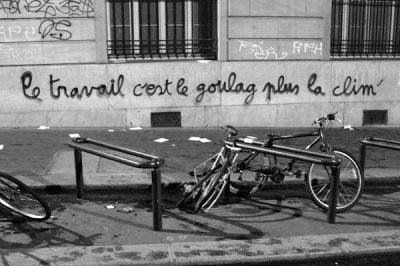
you can't play chess in flore...
Andrew Hussey's new book, Paris: the Secret History will be available this November, and it sounds like a good one. I might venture a bet that Paris has been the most profiled city in book lore (with new York and London as the other obvious contenders). The book claims to tell the history of the City of Light through its "whores and beggars... hustlers and vagabonds", and while Hussey recognizes the sad changes that the city's current touristic life requires (e.g. you can't play chess in Flore), he also reveals how Parisian life remains vital, and is perhaps experiencing a renaissance right now. Steven Poole has a lengthy review in the TLS.
Thursday, September 28, 2006

leonardo on paper
The Victoria & Albert Museum has a new exhibition, focussing on Leonardo Da Vinci's thought process as expressed on paper. The drawings include anatomical studies, mathematical expressions and designs for machinery.
Friday, September 22, 2006
 a new collected camus
Gallimard has issued an expanded and corrected complete works of Camus in its venerable Bibliotheque de la Pleiade series. Robin Buss has a review in the TLS.
sweet pages
Tim Richardson is the author of a history of confectionery entitled Sweets: History of a Temptation,(in America the title has been appropriately dumbed down to Sweets: A History of Candy) The British Library has a short interview and an illustrated selection of his favorite books from the history of sweets.
Sunday, September 10, 2006
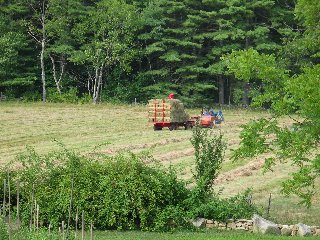
more about haying
We have about seven or eight acres of open pasture. It's been used for hay in the past, but was quickly headed toward becoming a field of weeds and, eventually, a woods again. Our neighbor Dave was kind enough to let me use his Farmall A with a sickle bar mower to cut the grass. Originally my plan was just to cut it before the weeds went to seed, and let it rot in the field as fertilizer for next year's hopefully healthier crop of hay. Hay mowing, it turns out, is nothing like mowing the lawn. It's hard work, especially on an older tractor (this one's from around 1943). At times one is practically wrestling with the machine to keep the sickle bar clear of clumps of hay, and the tractor in something of a straight line. I finished about half of the fields and had to stop mowing to replace the wooden pitman bar, a piece which is made of wood so that it might break if too much pressure is put on the blades, so as to not transmit the problem to the tractor's PTO (no need to explain this) or through to the engine.
 Fortunately, I was approached just then by a local farmer who asked if he could hay the field, and keep a percentage of the crop. I don't have access to the equipment to do a full haying myself, to say nothing of the required skill, so I jumped at the chance to watch someone who knows what they're doing cut the field. A few days later, some diesel pickups could be spotted idling at the edge of the field while the farmer, John T. and his crew made a plan. The cutting which remained was dispatched by John's son Jonathan, with a much more exact execution, making my half of the field look amateurish and uneven, with clumps of uncut grass and weeds still sticking up straight. Jonathan's rows were trimmed evenly, and they were straight.
The cut hay lay in the field for a few days turning gold as it dried. The Jonathan showed up again with his tractor towing an implement called a 'tedder'. The tedder uses long steel rotating fingers to lift and fluff the hay, allowing it to dry more thoroughly. The next day, A second tractor arrived, pulling a hay rake, and yet another tractor with the baler. The pick ups were pulling two hay wagons, one a six wheeler (that's the one in the picture with my last posting below).
 Four or five hours later, the two wagons were full with nearly two hundred seventy bales. Because I have limited use for the hay this year, I told John to keep all but 20 bales, which I'll likely use for mulch. The rest was his. Typically, a field owner would split the hay roughly 50/50 with the team that hays. In the future I expect we'll use that half for our sheep.
Friday, September 08, 2006
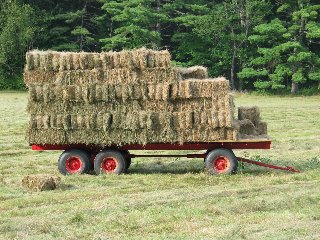
bluebirds / hay fields
Fall comes early here, and with it the bird migrations. Ducks and geese are frequent transients, but we've been waiting for the bluebirds. They were here last year, right after we moved in, playfully picking grasshoppers and crickets out of the high grass. But this year we've cut the grass around the house, and hayed the two pastures we could easily get farm equipment into. So would they return? Not to worry, yesterday around five in the afternoon Samantha and I were out back, when a flock of bluebirds emerged from the forest and headed for the marsh down the road. Packs of ten or fifteen birds at a time flapped and coasted across the green fields, thier little orange chests giving them away. There were likely more than one hundred in all. We hope some will stay for a few days at least.
Monday, August 14, 2006
Grisha's solution to Poincare's problem
A brief article in the NYTimes about the elusive Grisha's solution of Poincare's problem, and it's implications for mathematics.
Subscribe to:
Posts (Atom)