it's all destroyed
We've finally hit the point beyond which demolition starts to slow, and reconstruction picks up. The master bathroom is stripped to the studs, with the new plumbing roughed in. Mike should be laying down the subfloor for tiles, and the wonderboard for the shower wall foundation. It's a good thing he didn't start when he was scheduled, as the recent heavy rain has revealed a leak around the bathroom vent and the woodstove chimney, which rises behind the shower wall. In another week, it would all be sealed up, and we'd likely have to pull some of it out in the future.
The kitchen is significantly more destroyed than during my last post. The ceiling is entirely torn down, and all that remains is the old cast iron sink, which is too heavy to move by myself.
Samantha has been painting away (interiors only during this wet season), and we both hope to put down a new floor in the den next week. After that, we'll have lots of molding to put in, having removed much of it in the demolition.
Monday, October 03, 2005


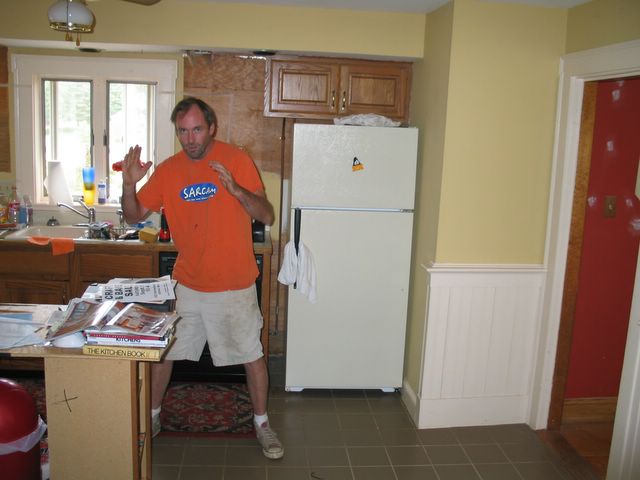

demolition man
Demolition, which seems like the simplest, most primitive, part of reconstruction, is actually quite a challenge. Removing a wall or ceiling, pipes or electrical lines generates new problems and possibilities at every turn. With the master bathroom fully demolished, I turned my attention to the kitchen. But after two days of Sawzall and sledgehammer work, it's down to the studs and plywood. All except the ceiling, which we've decided to remove entirely, revealing a small extension of "cathedral ceiling" above the center island and counters.
Deconstruction proceeds on the living room outside wall, where there will be a new pair of doors and a matching window, replacing the rotting wood siding and porthole-like octagonal window.
Thursday, September 29, 2005
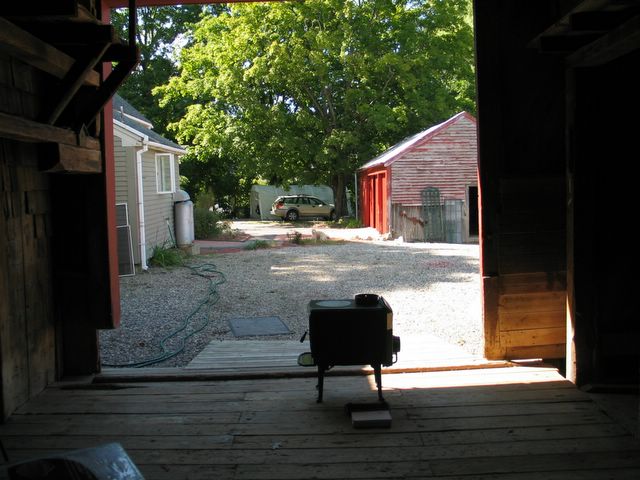


folding chairs
It's a shame I can't find or make more time to blog these days. Things are happening at such a quick pace. Been spending much of my time demolishing a bathroom down to the studs, and preparing a kitchen for similar destruction. In between there's talking to contractors, chimney sweeps, tractor salesmen and loggers (about cord wood). A bit of a change from Prospect Heights, Brooklyn.
Samantha and I are glad we opted for Maine where we have so many skilled friends, instead of Columbia County or Vermont where we know few people. The bathroom tilework is in the able hands of our friend Mike G., while the kitchen cabinets are being designed and built by Dave our source for occasional free sailing and the owner of Bullhouse Boat Works, a heritage craft wooden boat building business. We assume our kitchen will float when it is complete. Having knowledgable people to bounce things off of is an indispensible plus.
Although we've spent thousands on new tools in the last month, our most precious purchase was the two folding chairs which remain almost all of the furniture in the new place (everything else remains in storage). For lunch, or when we're just too tired to continue at the end of the day, we drag the chairs to the edge of the "patio" (read gravel) and look out at the field. The past two days have brought a change in birdlife in the trees and hedgerows, and a flock of bluebirds have arrived, diving into the grass for crickets and who knows what else. There were high winds today, and while we sat eating our lunch a cracking noise came from the forest as a tree laid itself down.
Sunday, September 11, 2005
Friday, July 29, 2005
a new home in Maine
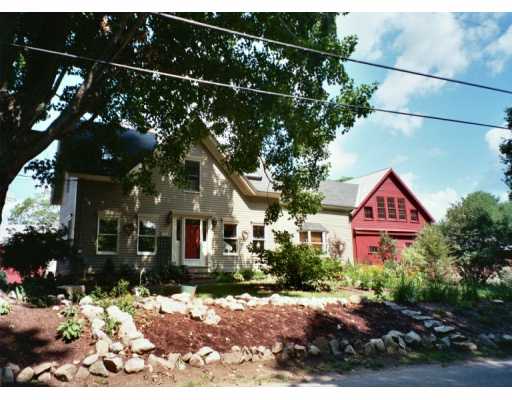
My posts have been infrequent and, for the most part, off topic for quite a while now. Sorry for the paucity of book related info. I hope you'll understand. Samantha and I have been planning our move for quite a while now, and after the sale of our place here in Brooklyn, things accelerated nicely. To add fuel to the fire, we found a place in Maine, made a bid this past Monday, and spent the last week gritting our teeth hoping that another bidder wouldn't beat us to the punch. We'll we're in contract now, and assuming the inspections go well, we will be closing on the 25th of August.
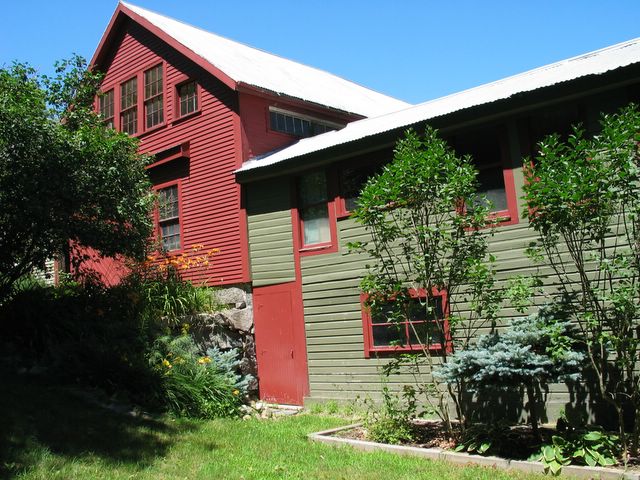
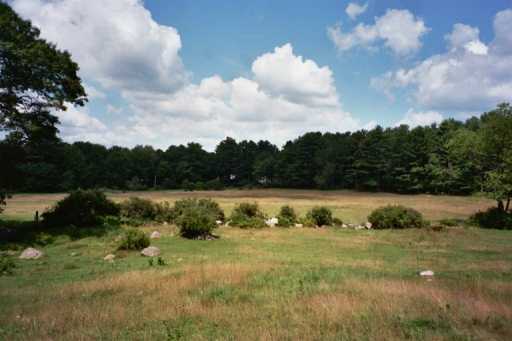
The new home is a mid 19th century farmhouse, with some later day renovations, and three attached barns, all on 18.5 acres of mixed farmland and forest. I fully expect that in no time at all, we will have an operational vineyard (for late harvest wines, naturally), bees, truffles, peacocks, goats, vicuna, alpacas and whatever other ridiculously impractical ideas we can come up with. More news soon.
Sunday, July 10, 2005
farm dreams
Been getting a bit carried away lately - reading more books about farming, daydreaming about erosion, and viewing tractors for sale on eBay. Our move still seems a long way off, but seems more real all the time.
Thursday, June 23, 2005
soil & soul
I recently made a reference to lots of good reading - a trend which has thankfully continued. Lately, my mind and reading table have been occupied with books about food, both eating and growing. This week I digested Scott Chaskey's This Common Ground, an ode to organic farming by an experienced farmer, a talented poet and a patient man. Chaskey charts the benefits to soul and soil and in this description of the seasons on Quail Hill Farm CSA in Amagansett, NY which he ran for many years. My subway reading has been Waverley Root's The Food of France. Root's book, which is arranged as a travelogue of sorts, loudly celebrates the local forces which create cuisine (geography, politics, culture, etc.). Originally published in 1958, the book was claiming the importance of terroir for food and and wine long before organic farming was a necessary reaction to the despoilation of our farmland by "modern farming methods". Compiled three decades later, Andries de Groot's collection of essays, In Search of the Perfect Meal echoes many of Root's ideas about the important of location in formation of cuisine. Samantha was wonderful enough to get me two books of Hugh Fearnley-Whittingstall - The massive and thorough River Cottage Meat Book, and his seasonally based farm cookbook, The River Cottage Year. I've only begun to cook from the River Cottage Year, trying the lettuce risotto, rhubarb trifle, and a few others, all to great satisfaction. I'm slowly plodding through the Meat Book in the hot weather, hoping for the fall, when the idea of a few hours over a hot stove won't seem so difficult.
Saturday, June 18, 2005
summer catalogue - parts 1&2
After much cataloging and scanning, I've finally finished both parts of my summer catalogue. It's arranged alphabetically, with part 1 covering the first half of the century, and part 2 the second half. While much of the catalogue is given over to the historical avant-gardes, there are many items in the fields of design, architecture, literature, modern thought and culture. I'll be integrating the catalogues into my website soon.
Sunday, June 12, 2005
June slides by
This has been an impossible month, with Samantha and me putting the apartment on the market and trying to imagine just what is next. My reading has taken a turn toward the bucolic, with lots of food related books (both old and new) making it to the bedside table. More about those books later. We've both been separately grappling with the idea of writing, and imagining that our new rural surroundings may aid in that process. Of course, this is a fantasy. Samantha, though has been working on it all along - her blog has become more than a dumping place for the daily brain clutter, or a rehash of interesting links. It's really an investigation of the process of baking, and of becoming a baker, from the inside out. What's more, she's developing readers, well beyond the well-wishing friends and relatives that form every (well most) writers' first audience. I'm just a bit jealous.
I've been wrapped up in the appraisal of the archive of a well-known horror writer. In fact a very nice, very literary chap. This constant exposure to the process of writing, seems to be having an effect on the way I organize my thoughts. Certainly, it helps to demystify the workings of the writers' mind when you see the constant revising, the complete but discarded novels, the thousands of pages written before recognition reveals itself. When craft is laid out in front of you like this, it seems more possible, but much more work.
Friday, May 20, 2005
While the blogging has been on hiatus, it's been a month of great reading. Last night finished Zbigniew Herbert's King of the Ants, a retelling and extension of a mythological stories. The narrator assumes an attitude of amused consideration, filling in gaps in the original tales, or following incomplete threads to a previously unspoken conclusion. While the book hasn't the sheer brilliance of Barbarian in the Garden, it still provides a peak into the swirl of ideas which is Herbert's mind.
Tuesday, May 03, 2005
Friday, April 01, 2005
it's spaghetti harvest time
For one of the great hoaxes in history, look to the British. The august BBC ran a piece on a news program called Panorama, in which a highly-respected journalist, Richard Dimbleby, delivered with absolute seriousness a story about the Swiss Spaghetti Harvest. Spaghetti was relatively unknown at that time in the U.K. and viewers began calling the BBC asking how they could grow their own spaghetti tree. The BBC encouraged caller to place a stick of spaghetti upright in a can of tomato sauce. Here's the transcript:
It isn't only in Britain that spring this year has taken everyone by surprise. Here, in the Ticino, on the borders of Switzerland and Italy, the slopes overlooking Lake Lugano have already burst into flower at least a fortnight earlier than usual. But what, you may ask, has the early and welcome arrival of bees and blossoms to do with food? Well, it's simply that the past winter, one of the mildest in living memory, has had its effect in other ways as well. Most important of all, it's resulted in an exceptionally heavy spaghetti crop.The last two weeks of March are an anxious time for the spaghetti farmer. There's always the chance of a late frost which, while not entirely ruining the crop, generally impairs the flavor and makes it difficult for him to obtain top prices in world markets. But now these dangers are over and the spaghetti harvest goes forward.
Spaghetti cultivation here in Switzerland is not, of course, carried out on anything like the tremendous scale of the Italian industry. Many of you, I'm sure, will have seen pictures of the vast spaghetti plantations in the Po valley. For the Swiss, however, it tends to be more of a family affair. Another reason why this may be a bumper year lies in the virtual disappearance of the spaghetti weevil, the tiny creature whose depredations have caused much concern in the past. After picking, the spaghetti is laid out to dry in the warm alpine sun. Many people are often puzzled by the fact that spaghetti is produced of such uniform length but this is the result of many years of patient endeavor by plant breeders who have succeeded in producing the perfect spaghetti.And now the harvest is marked by a traditional meal. Toasts to the new crop are drunk in these boccalinos. And then the waiters enter bearing the ceremonial dish and it is, of course, spaghetti, picked earlier in the day, dried in the sun, and so brought fresh from garden to table at the very peak of condition. For those who love this dish, there's nothing like real, home-grown spaghetti.
- thanks to Manhattan User's Guide for the info.
Subscribe to:
Posts (Atom)