a visit to Papermania
This Saturday, Samantha and I made the three hour drive from Maine to Hartford, CT to attend the giant ephemera fair called Papermania. We got there a bit after opening, but spent the entire day browsing through booths piled high with unusual items: books, prints, photographs, advertising art and postcards. In the end, we bought two big bags of items, and could have spent even more time there. There were lots of friends and colleagues both exhibiting and in attendance as purchasers, and it was a pleasure to meet some dealers we haven't previously seen on the book fair circuit. I have to say, though, that also there were some of the strangest dealers I have yet to meet. First there were the three (count 'em) dealers who had no business cards or other info about their businesses and were unwilling to give out info otherwise. Then there was the dealer with an original drawing by an interesting artist, who had no price. Was it his item? "Yes." Is it for sale? "Yes." What's the price? "I don't know." This pattern was repeated later in the show with a dealer who had a notice about an important and expensive book taped up in his booth. Is it for sale? "Yes." How much? "I don't know." Are you intending to sell it? "Yes, but I need to find a rich man to buy it." We'll you're not going to find him this way. Finalyl there was the dealer gone AWOL. I myself am guilty of leaving my booth to browse a fair or seek some sustenance, but I found myself in a booth, books in hand, ready to buy. The dealer was missing - fine. I checked with the neighbors and was told that they had gone to a basketball game(?). I returned an hour and two hours later and found an empty booth. My selection of books remained on the folding chair, with my business card tucked inside. No dealer (and no call on the phone by today). Is there any wonder that booksellers are going out of business? Of course, these situations were frustrating, but still unusual examples of my interactions with the dealers at Papermania. And I'll be back there again next show.
Sunday, December 24, 2006
a few of my favorite blogs
In the spirit of the holiday, I'd like to send a thank you to a few of my favorite blogs and sites. I turn to these not so much for information (I have separate list to thank for that - perhaps later), but for the quality of the experience, some thoughtful reflection, and sometimes both. Giornale Nuovo, is the work of one Mr H., a youngish man living in Sweden with a keen sense of style regarding historical graphics. Favorite recent posts have included: Engraved and Etched English Title Pages and Basoli's Alphabet
Mark Woods, an Ottowan, runs Wood s Lot, a a hefty mash-up of thoughtful text snippets and images selected from across the ages. This is one of the most philosophical (in the sense of humanistic tradition), sites I know, and I find it a salve for the frazzled internet work in whch I normally find myself. It's not unusual to find texts by Miguel de Unamuno, Laura Riding Jackson and Walter Benjamin matched with art work by Joseph Cornell.
Both of these sites are also presented in a simple, almost minimalist format, which is such a relief from the visual mess provided by most blogs/sites these days.
In the spirit of the holiday, I'd like to send a thank you to a few of my favorite blogs and sites. I turn to these not so much for information (I have separate list to thank for that - perhaps later), but for the quality of the experience, some thoughtful reflection, and sometimes both. Giornale Nuovo, is the work of one Mr H., a youngish man living in Sweden with a keen sense of style regarding historical graphics. Favorite recent posts have included: Engraved and Etched English Title Pages and Basoli's Alphabet
Mark Woods, an Ottowan, runs Wood s Lot, a a hefty mash-up of thoughtful text snippets and images selected from across the ages. This is one of the most philosophical (in the sense of humanistic tradition), sites I know, and I find it a salve for the frazzled internet work in whch I normally find myself. It's not unusual to find texts by Miguel de Unamuno, Laura Riding Jackson and Walter Benjamin matched with art work by Joseph Cornell.
Both of these sites are also presented in a simple, almost minimalist format, which is such a relief from the visual mess provided by most blogs/sites these days.
Thursday, December 21, 2006

Poet Piergiorgio Welby gets his wish
Piergiorgio, Italian poet dies with dignity. Conservatives do what they can to stifle that dignity, and demand the arrest of the doctor who sedated him and removed him from his hospital respirator. Piergiorgio has been blogging about his desire to control his own destiny for some time, logging over 1000 entries by tapping out the words with a stick on a computer keyboard. He also wrote an open letter to the President of Italy, in support of control of his own life, and included this short, powerful evocation of real life, "“Life is the woman who loves you, the wind through your hair, the sun on your face, an evening stroll with a friend. Life is also a woman who leaves you, a rainy day, a friend who deceives you. I am neither melancholic nor manic-depressive. I find the idea of dying horrible. But what is left to me is no longer a life.”
Adam Bellow, pamphleteer for the 21st century
Can the pamphlet bring ideas back into publishing for the masses? Saul Bellow's son Adam thinks so, and looks to Haldeman-Julius' Little Blue Books as a model.
Can the pamphlet bring ideas back into publishing for the masses? Saul Bellow's son Adam thinks so, and looks to Haldeman-Julius' Little Blue Books as a model.
"We've learned nothing in 12,000 years"
Picasso on paleolithic cave art, in Gregory Curtis' new book, The Cave Painters.
Picasso on paleolithic cave art, in Gregory Curtis' new book, The Cave Painters.
Friday, December 15, 2006
Borges manuscripts turn up
Relief is in the air in Cambridge as Lame Duck's two lost Borges manuscripts turn up tucked into another item.
Relief is in the air in Cambridge as Lame Duck's two lost Borges manuscripts turn up tucked into another item.
Volbracht's Myko Libri
Every so often a bibliography comes along that's not just a handy tool. The great books on books can be beautiful objects in themselves, beautifully designed and a pleasure to pore over. Jurgen Holstein's recent survey of modern dust jacket design, and the multi-volume collection of juveniles, The Children's World of Learning 1480 -1880, published by Antiquariaat Forum come to mind. My new favorite bibliography is Christian Volbracht's new catalogue of his own collection of books on mushrooms, Myko Libri, Die Bibliothek der Pilzbucher. Volbracht has gone to great trouble to create a publication worthy of his great collection. Published by the author in a signed, limited edition of 750 copies, the book contains more then 2300 entries, and is illustrated in color throughout, with a mixture of title pages, plates and decorated book covers. A number of indices provide quick lists of various subject areas, from early works (Pliny's 1481 Historia Naturalis is the first) to regional publications, books on mycogastronomy, hallucinogens and iconography. The quarto-sized tome is handsomely bound in brown cloth with an illustrated dust jacket.
Every so often a bibliography comes along that's not just a handy tool. The great books on books can be beautiful objects in themselves, beautifully designed and a pleasure to pore over. Jurgen Holstein's recent survey of modern dust jacket design, and the multi-volume collection of juveniles, The Children's World of Learning 1480 -1880, published by Antiquariaat Forum come to mind. My new favorite bibliography is Christian Volbracht's new catalogue of his own collection of books on mushrooms, Myko Libri, Die Bibliothek der Pilzbucher. Volbracht has gone to great trouble to create a publication worthy of his great collection. Published by the author in a signed, limited edition of 750 copies, the book contains more then 2300 entries, and is illustrated in color throughout, with a mixture of title pages, plates and decorated book covers. A number of indices provide quick lists of various subject areas, from early works (Pliny's 1481 Historia Naturalis is the first) to regional publications, books on mycogastronomy, hallucinogens and iconography. The quarto-sized tome is handsomely bound in brown cloth with an illustrated dust jacket.
Monday, November 20, 2006
Ehon: The Artist and the Book in Japan
The New York Public Library has a fantastic new exhibition up currently, titled Ehon: The Artist and the Book in Japan. Ehon surveys the development of the Japanese picture book, a 1350 year history which began in the eighth century. The survey extends through the Japanese Avant-Garde, including the MAVO movement, through to Anime and the contemporary photographic artist book. While I have not yet seen the exhibit, I did order the 380 page companion volume, published by the NYPL and the University of Washington Press. It a beautiful book, with enough illustration to truly draw you into these visual wonders. The show runs through February, 2007.
The New York Public Library has a fantastic new exhibition up currently, titled Ehon: The Artist and the Book in Japan. Ehon surveys the development of the Japanese picture book, a 1350 year history which began in the eighth century. The survey extends through the Japanese Avant-Garde, including the MAVO movement, through to Anime and the contemporary photographic artist book. While I have not yet seen the exhibit, I did order the 380 page companion volume, published by the NYPL and the University of Washington Press. It a beautiful book, with enough illustration to truly draw you into these visual wonders. The show runs through February, 2007.
Friday, September 29, 2006
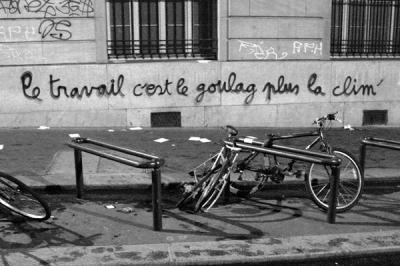
you can't play chess in flore...
Andrew Hussey's new book, Paris: the Secret History will be available this November, and it sounds like a good one. I might venture a bet that Paris has been the most profiled city in book lore (with new York and London as the other obvious contenders). The book claims to tell the history of the City of Light through its "whores and beggars... hustlers and vagabonds", and while Hussey recognizes the sad changes that the city's current touristic life requires (e.g. you can't play chess in Flore), he also reveals how Parisian life remains vital, and is perhaps experiencing a renaissance right now. Steven Poole has a lengthy review in the TLS.
Thursday, September 28, 2006

leonardo on paper
The Victoria & Albert Museum has a new exhibition, focussing on Leonardo Da Vinci's thought process as expressed on paper. The drawings include anatomical studies, mathematical expressions and designs for machinery.
Friday, September 22, 2006
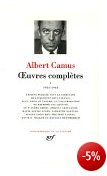 a new collected camus
 Gallimard has issued an expanded and corrected complete works of Camus in its venerable Bibliotheque de la Pleiade series. Robin Buss has a review in the TLS.
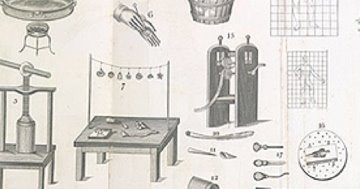
sweet pages
Tim Richardson is the author of a history of confectionery entitled Sweets: History of a Temptation,(in America the title has been appropriately dumbed down to Sweets: A History of Candy) The British Library has a short interview and an illustrated selection of his favorite books from the history of sweets.
Sunday, September 10, 2006
more about haying
We have about seven or eight acres of open pasture. It's been used for hay in the past, but was quickly headed toward becoming a field of weeds and, eventually, a woods again. Our neighbor Dave was kind enough to let me use his Farmall A with a sickle bar mower to cut the grass. Originally my plan was just to cut it before the weeds went to seed, and let it rot in the field as fertilizer for next year's hopefully healthier crop of hay. Hay mowing, it turns out, is nothing like mowing the lawn. It's hard work, especially on an older tractor (this one's from around 1943). At times one is practically wrestling with the machine to keep the sickle bar clear of clumps of hay, and the tractor in something of a straight line. I finished about half of the fields and had to stop mowing to replace the wooden pitman bar, a piece which is made of wood so that it might break if too much pressure is put on the blades, so as to not transmit the problem to the tractor's PTO (no need to explain this) or through to the engine.
 Fortunately, I was approached just then by a local farmer who asked if he could hay the field, and keep a percentage of the crop. I don't have access to the equipment to do a full haying myself, to say nothing of the required skill, so I jumped at the chance to watch someone who knows what they're doing cut the field. A few days later, some diesel pickups could be spotted idling at the edge of the field while the farmer, John T. and his crew made a plan. The cutting which remained was dispatched by John's son Jonathan, with a much more exact execution, making my half of the field look amateurish and uneven, with clumps of uncut grass and weeds still sticking up straight. Jonathan's rows were trimmed evenly, and they were straight.
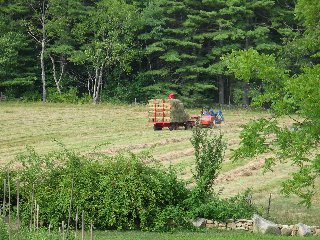
The cut hay lay in the field for a few days turning gold as it dried. The Jonathan showed up again with his tractor towing an implement called a 'tedder'. The tedder uses long steel rotating fingers to lift and fluff the hay, allowing it to dry more thoroughly. The next day, A second tractor arrived, pulling a hay rake, and yet another tractor with the baler. The pick ups were pulling two hay wagons, one a six wheeler (that's the one in the picture with my last posting below).
 Four or five hours later, the two wagons were full with nearly two hundred seventy bales. Because I have limited use for the hay this year, I told John to keep all but 20 bales, which I'll likely use for mulch. The rest was his. Typically, a field owner would split the hay roughly 50/50 with the team that hays. In the future I expect we'll use that half for our sheep.
Friday, September 08, 2006

bluebirds / hay fields
Fall comes early here, and with it the bird migrations. Ducks and geese are frequent transients, but we've been waiting for the bluebirds. They were here last year, right after we moved in, playfully picking grasshoppers and crickets out of the high grass. But this year we've cut the grass around the house, and hayed the two pastures we could easily get farm equipment into. So would they return? Not to worry, yesterday around five in the afternoon Samantha and I were out back, when a flock of bluebirds emerged from the forest and headed for the marsh down the road. Packs of ten or fifteen birds at a time flapped and coasted across the green fields, thier little orange chests giving them away. There were likely more than one hundred in all. We hope some will stay for a few days at least.
Monday, August 14, 2006
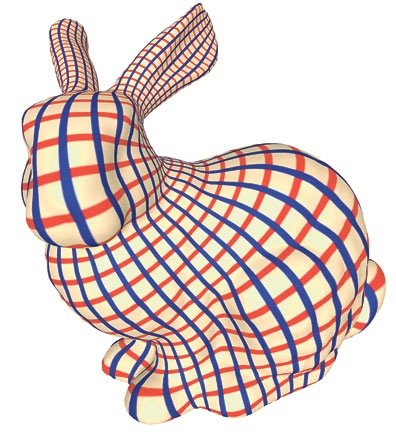
Grisha's solution to Poincare's problem
A brief article in the NYTimes about the elusive Grisha's solution of Poincare's problem, and it's implications for mathematics.
Thursday, August 10, 2006
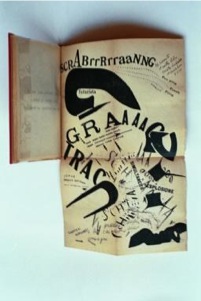
futurist visual poetry at the Getty
A Tumultous Assembly: Visual Poems of the Italian Futurists opened this week at the Getty Center. It runs through January 7, 2007.
Sunday, July 23, 2006
what I seek in a bibliography
My personal library is partially posted on librarything.com, and I've had an interesting inquiry about the Gabler Bibliography of English language wine books, Wine Into Words, 2nd Edition. I have given the book a rating of 3 stars in my library, and another lister wanted to know why not higher. I think the Gabler book is a fine book, and there is nothing else out there which approaches its usefulness. Gabler has clearly spent more time with American and English wine books than anyone I am aware of, and deserves praise for that.
If I am reluctant to praise the book higher, it is because it is too inclusive and not selective enough. In my experience, there are two types of bibliographies: one is completely inclusive, and lists every last item which ever existed on its subject (author bibliographies are typically of this sort, and should be); the second type is much more subjective, and typically relects the selections of a long term collector or scholar(s). Bibliographies in this second category might include Howes (American imprints). Printing and the Mind of Man (the history of ideas) or the Roth 101 (the photo book). In these cases the bibliographer guides the reader through a large field, toward the books which are (in the author's opinion) truly important. In both cases the bibliographies have also done much to shape the bookselling and collecting markets in their respective fields. They reflect a true connoiseurship. Gabler, who has done much to improve his book in the second edition, still includes many, many mediocre books in the list, books which serve little purpose for the collector unless one just seeks every last English language book on th subject. To me, this lessens the effect of the valuable comments Gabler has included on many entries, and moves the book toward being a checklist.
That said, the book remains very useful and I recommend it if you don't already have it.
My personal library is partially posted on librarything.com, and I've had an interesting inquiry about the Gabler Bibliography of English language wine books, Wine Into Words, 2nd Edition. I have given the book a rating of 3 stars in my library, and another lister wanted to know why not higher. I think the Gabler book is a fine book, and there is nothing else out there which approaches its usefulness. Gabler has clearly spent more time with American and English wine books than anyone I am aware of, and deserves praise for that.
If I am reluctant to praise the book higher, it is because it is too inclusive and not selective enough. In my experience, there are two types of bibliographies: one is completely inclusive, and lists every last item which ever existed on its subject (author bibliographies are typically of this sort, and should be); the second type is much more subjective, and typically relects the selections of a long term collector or scholar(s). Bibliographies in this second category might include Howes (American imprints). Printing and the Mind of Man (the history of ideas) or the Roth 101 (the photo book). In these cases the bibliographer guides the reader through a large field, toward the books which are (in the author's opinion) truly important. In both cases the bibliographies have also done much to shape the bookselling and collecting markets in their respective fields. They reflect a true connoiseurship. Gabler, who has done much to improve his book in the second edition, still includes many, many mediocre books in the list, books which serve little purpose for the collector unless one just seeks every last English language book on th subject. To me, this lessens the effect of the valuable comments Gabler has included on many entries, and moves the book toward being a checklist.
That said, the book remains very useful and I recommend it if you don't already have it.
Friday, July 07, 2006
now all of your favorite classical works in one handy volume!
The Weekly Standard has a review of a new collection of samples from the Loeb Classical library, along with a short history of the imprint. Already a resource for the inquiring "everyman" more than the classically educated scholar, the library now needs a one-volume edition to reach what passes for the educated today.
"The source of the Loeb Library's cachet may be shrouded from us in a trifling age, but that of their popularity isn't hard to discover: Along with the original Greek and Latin texts printed on the left-hand page as each book opens--texts, to say the least, of circumscribed value to most people--on the right-hand side we find crisp, unembellished English translations. The Loebs are the world's classiest crib, a trot for grownups. They are classics with a safety net. Here was an excellent innovation for those who have mentally mislaid the mastery of the classical languages they gained in schooldays. Here was also a perfect device for those who never learned them, and they make a somewhat larger crowd these days."
The Weekly Standard has a review of a new collection of samples from the Loeb Classical library, along with a short history of the imprint. Already a resource for the inquiring "everyman" more than the classically educated scholar, the library now needs a one-volume edition to reach what passes for the educated today.
"The source of the Loeb Library's cachet may be shrouded from us in a trifling age, but that of their popularity isn't hard to discover: Along with the original Greek and Latin texts printed on the left-hand page as each book opens--texts, to say the least, of circumscribed value to most people--on the right-hand side we find crisp, unembellished English translations. The Loebs are the world's classiest crib, a trot for grownups. They are classics with a safety net. Here was an excellent innovation for those who have mentally mislaid the mastery of the classical languages they gained in schooldays. Here was also a perfect device for those who never learned them, and they make a somewhat larger crowd these days."
Wednesday, July 05, 2006
Mezzo-soprano Lorraine Hunt Lieberson has died.
Never far from my CD player, Lieberson's recording of Bach's Cantatas BWV 82 and 199, has been a favorite piece of music of mine for the last few years, both a consolation and a provocation to deeper feeling. The NY Times obit today reviews her career.
"...her shattering performances several years ago in two Bach cantatas for solo voice and orchestra, staged by the director Peter Sellars, seen in Lincoln Center's New Visions series, with the Orchestra of Emmanuel Music, Craig Smith conducting.
In Cantata No. 82, "Ich Habe Genug" ("I Have Enough"), Ms. Hunt Lieberson, wearing a flimsy hospital gown and thick woolen socks, her face contorted with pain and yearning, portrayed a terminally ill patient who, no longer able to endure treatments, wants to let go and be comforted by Jesus. During one consoling aria, "Schlummert ein, ihr matten Augen" ("Slumber now, weary eyes"), she yanked tubes from her arms and sang the spiraling melody with an uncanny blend of ennobling grace and unbearable sadness."
Never far from my CD player, Lieberson's recording of Bach's Cantatas BWV 82 and 199, has been a favorite piece of music of mine for the last few years, both a consolation and a provocation to deeper feeling. The NY Times obit today reviews her career.
"...her shattering performances several years ago in two Bach cantatas for solo voice and orchestra, staged by the director Peter Sellars, seen in Lincoln Center's New Visions series, with the Orchestra of Emmanuel Music, Craig Smith conducting.
In Cantata No. 82, "Ich Habe Genug" ("I Have Enough"), Ms. Hunt Lieberson, wearing a flimsy hospital gown and thick woolen socks, her face contorted with pain and yearning, portrayed a terminally ill patient who, no longer able to endure treatments, wants to let go and be comforted by Jesus. During one consoling aria, "Schlummert ein, ihr matten Augen" ("Slumber now, weary eyes"), she yanked tubes from her arms and sang the spiraling melody with an uncanny blend of ennobling grace and unbearable sadness."
Sunday, July 02, 2006
 ferlinghetti asea
There's a nice short profile of and interview with Lawrence Ferlighetti in today's Guardian. In it he describes his life on a sub-chaser in WWII. "Any smaller than us you weren't a ship, you were a boat. But we could order anything a battleship could order so we got an entire set of the Modern Library. We had all the classics stacked everywhere all over the ship, including the john. We also got a lot of medicinal brandy the same way."
Subscribe to:
Posts (Atom)